Table of contents
How to Calculate Embedding Loss in Bolted Joint: From Theory to Measurement
Bolted joints are widely used across industries — from aerospace to automotive, from construction to energy — because they provide a strong, reversible, and cost-efficient connection. Yet, engineers know that a bolted joint is not a “set and forget” system. One of the main phenomena affecting joint integrity is embedding loss, also known as settlement.
In this article, we will explore what embedding loss means, how to calculate it, why it matters, and why direct measurement with advanced instruments such as the TRAXX M2 bolt tension meter often provides a more reliable answer than theory alone.
What is Embedding Loss in Bolted Joint?
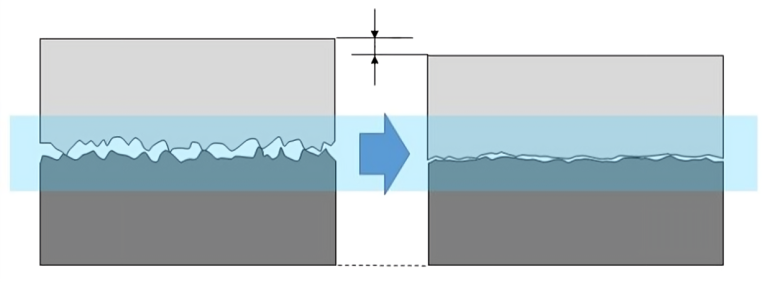
When a bolt is tightened, the clamped parts are compressed together. This compression is never perfectly elastic: under the high local pressure beneath the bolt head, nut, or washer, the contact surfaces undergo microscopic plastic deformation.
This phenomenon — flattening of surface roughness, crushing of coatings or paint, local yielding — causes a reduction of the effective clamped length. The result is a drop in bolt tension (preload) after tightening, even if the bolt has not rotated or slipped.
The surface reality
Although machined surfaces appear smooth, under magnification they are covered in asperities. The real contact occurs only at these peaks. Under load, the asperities deform plastically, which explains why embedding loss is concentrated at specific interfaces: under the bolt head, nut face, washers, and within the thread itself
Typical values
Per interface: 1 to 7 µm.
Clean machined surfaces: 5–30 µm total.
Painted or coated surfaces: up to 0.05–0.1 mm.
Soft materials or multilayer joints: even higher.
Though these numbers may appear small, the loss in preload can easily reach 10–20% of the initial bolt tension — enough to compromise sealing, fatigue life, or safety.
Timing of embedding
Most of the settlement occurs:
shortly after tightening, during the first relaxation phase, and
during the first service load cycle.
This means that even if a bolt appears correctly tightened at assembly, its effective preload may drop significantly once the joint is subjected to real operating conditions.
How to Calculate embedding loss in Bolted Joint
Engineers often ask: how to calculate embedding loss in bolted joint?
The calculation relies on a simplified spring model of the joint.
Let:
Δu: total settlement (mm) — the vertical “collapse” of contact surfaces.
kb: stiffness of the bolt (N/mm).
kj: stiffness of the joint (N/mm).
The loss of preload can be expressed as:
ΔF=(kb x kj/kb+kj)Δu

Step 1 — Bolt stiffness
kb≈(As x E)/Lb
where
As = tensile stress area of the bolt,
E = modulus of elasticity of steel (~210 GPa),
Lb = effective length under tension.
Step 2 — Joint stiffness
The joint stiffness depends on the geometry of the compressed members. Analytical models approximate the compressed volume as a truncated cone beneath the bolt head and nut. Values can also be obtained experimentally.
Step 3 — Estimate settlement Δu
This is the most uncertain parameter. It depends on surface roughness, coatings, and assembly conditions. Engineers often rely on reference values (1–7 µm per interface) or empirical testing
Example of how to calculate embedding loss in bolted joint
Bolt: M12, As=84.2 mm², Lb=50mm.
kb≈354 kN/mm.
Joint stiffness kj≈1000 kN/mm.
Settlement Δu=0.02 mm.
Result:
ΔF≈5.2 kN
For an initial preload of 30 kN, this corresponds to ~17% loss — clearly significant.
Why Diameter Matters
One striking observation is that embedding loss is more critical for small bolts:
For an M12 joint, a 15 µm settlement might cause ~12% preload loss.
For an M4 joint, the same settlement can lead to ~38% loss
This makes embedding especially dangerous in small fasteners, electronics, or lightweight assemblies.
The Limitations of Calculation
While the formula is elegant, its accuracy is limited:
Uncertainty of settlement values: predicting how many microns a surface will embed is nearly impossible without testing.
Variability of joint stiffness: real geometries, coatings, and material stacks differ from simplified models.
Environmental effects: temperature, vibration, and creep can add to the loss.
In other words, calculations provide an estimate, but not a guarantee.
Measuring Embedding Loss in bolted joint with the TRAXX-M2
This is where measurement comes into play. After the tightening process and the initial relaxation period, the TRAXX M2 bolt tension meter allows engineers to directly measure the actual residual bolt tension.
Unlike torque-based methods, which only infer preload indirectly, the TRAXX M2 uses ultrasonic technology to measure bolt elongation and calculate the precise clamp load.
With this approach, embedding loss is no longer hypothetical:
Tighten the joint.
Let it settle (minutes, hours, or as per procedure).
Measure with the TRAXX M2.
The difference in bolt tension is the real embedding loss for that specific joint, under its actual surface and assembly conditions.
Embedding loss in bolted joint : Conclusion
Calculating embedding loss in a bolted joint is possible with spring models and settlement estimates. However, these remain approximations, often based on assumptions that can vary widely in practice.
For engineers and industries where safety, performance, and reliability matter, the best approach is measurement.
The TRAXX M2 bolt tension meter provides a direct, accurate, and repeatable way to quantify embedding loss in real conditions — turning a theoretical uncertainty into a reliable data point.
👉 In short: how to calculate embedding loss in bolted joint is a valuable engineering exercise, but how to measure it with TRAXX M2 is the real answer.