
Table of contents
This article delves into a detailed examination of this approach, shedding light on its significant advantages, particularly in the context of monitoring critical assemblies in challenging environments.
An introduction to monitoring torque in bolts using an embedded fiber optic sensor
Bolts are ubiquitous in industrial engineering, playing a crucial role in assessing their tightness and predicting the service life of bolted connections. This estimation aids in cost savings and enhances the efficiency of engineering maintenance programs. The primary failure mode observed in bolted joints is the loosening of nuts and bolts due to changes induced by contact pressure, jeopardizing safety. Additionally, torque wrenches used for fastening bolt joints are susceptible to errors, mainly attributed to pre-tightening forces, including friction and lubricant levels. Consequently, there is an escalating focus on bolt load monitoring and control, with various methods such as ultrasonic measurements, active piezoelectric sensing, and piezoelectric impedance approach explored in the literature.
Testing pre-tightening force and thread fatigue
With the surge in sustainable energy, modern offshore wind turbines, comprising numerous components, demand meticulous attention. A significant percentage of bolts in a turbine must undergo regular sampling for visual inspection and non-destructive testing. Each turbine tower, consisting of approximately 450–500 bolts, necessitates testing for pre-tightening force and thread fatigue. Insufficient pre-tension between bolted flanged connections is a major cause of bolt malfunction, resulting from constant and repeated loading, generating significant friction and reducing tightening force. Traditional bolt monitoring approaches rely on the tightness of the bolt connection, and various methods such as ultrasonic and piezoelectric impedance face challenges due to the need for expensive equipment.
What is Fiber Bragg grating (FBG) sensors ?
Fiber Bragg grating (FBG) sensors emerge as a favorable choice for bolted joint monitoring due to their precision, lightweight, and low electromagnetic interference. The literature reveals diverse applications of fiber optic sensor in bolt tension monitoring, incorporating different fixation methods and demonstrating varied responses. In this study, we propose a novel FBG-based bolt torque sensor for measuring pre-tightening force, facilitating remote monitoring, and controlling stress conditions in wind turbines. This approach aims to ascertain the tightening status and structural health of wind turbine bolts while minimizing the time and cost associated with bolt inspection. The implications of this research extend to large-scale facilities and structural engineering in areas such as railways, bridges, and construction sites.
How do you measure bolt load using a fiber optic sensor ?
Employing fiber optic sensors for torque control offers an advanced technical solution, leveraging the unique properties of optical transmission to ensure precise measurement of stresses exerted on bolts within an assembly. The direct integration of these sensors into the bolts provides a real-time monitoring methodology, enabling the detection and assessment of tension variations with exceptional sensitivity.
This approach proves particularly well-suited to challenging environments where operational conditions can be severe. Strategic assemblies, subject to significant mechanical stresses, benefit from continuous and reliable monitoring through fiber optic technology. These environments often involve extreme temperature variations, frequent vibrations, or exposure to corrosive substances—factors that could compromise the integrity of traditional assemblies.
Why monitoring bolt load with fiber optic sensor ?
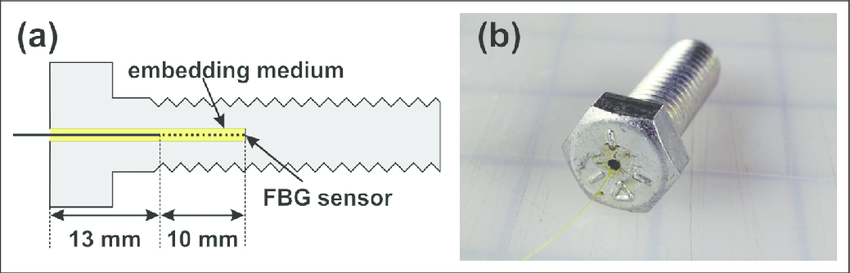
The underlying mechanics of this solution rely on the ingenious integration of fiber optic sensors directly into screws, studs, and other threaded rods, starting from a diameter of M3. The implementation process of this technology begins with integrating an optical fiber directly into the bolt, which is secured through a specialized bonding process. This approach ensures a reliable structural connection between the bolt and the fiber, guaranteeing optimal transmission of stress variations.
Retrofitting is a possibility, meaning the modification of existing fasteners by retroactively incorporating these sensors. However, in most cases, it is more prudent to opt for the direct ordering of pre-equipped bolts with these sensors, optimizing the consistency of the entire system. This approach ensures a seamless integration and maximizes the reliability of the monitoring device.
The bolt tightening process results in elongation of the optical fiber. This phenomenon arises from the mechanical forces exerted during tightening, inducing a measurable deformation in the fiber. The strain sensor, sensitive to these variations, precisely detects changes in the fiber’s length, providing an instantaneous and accurate readout of the stresses experienced by the bolt.
Key points about monitoring bolt load with fiber optic sensor
Precision:
The fiber optic torque control technology offers exceptional precision in monitoring mechanical assemblies. Based on the innovative principle of integrating 0.25 mm diameter optical fibers into screws, studs, and other threaded rods, this system relies on a sophisticated methodology to ensure reliable measurement of stress variations.
Challenging Implementation and Cost:
Implementing this optical fiber is carried out with particular precision, placing the fiber in the center of a 0.5 mm axial hole and securely anchoring it to the bolt using a polymerization bonding process. This process imparts exceptional resistance to temperature exposures, reaching up to 320°C. The complexity of this procedure increases the production costs of each bolt in the assembly.
Principle: Polarimetric Interferometry:
The fiber optic technology employed relies on a patented process of polarimetric interferometry in white light. This allows precise calculation of minute length variations by emitting light, whose spectrum is a light wave. Projected onto a set of mirrors, this light generates return signals analyzed to determine the bolt’s elongation with remarkable precision at a scale of 0.5 µm.
Interrogator Unit:
The fiber connection, whether done before or after tightening, is ensured by a connector. This connector links the probe to a device called an “interrogator,” remotely positioned through cable routing over distances of up to 7 kilometers. This interrogator is designed to simultaneously handle up to 1000 probes, allowing efficient and centralized management of multiple control points within a single system.
Consideration of Other Parameters:
This same fiber optic technology, beyond its application to torque control, also offers the ability to detect temperature, pressure, and displacements with great precision. The interrogator, central to this system, orchestrates the smooth management of all these sensors, highlighting the versatility and robustness of this approach in advanced mechanical control.
Monitoring elongation evolution closely
The elongation of bolts serves as a crucial indicator in various operational scenarios, manifesting in different ways:
Loosening of Fasteners:
When fasteners loosen, an evolution of bolt elongation can be observed. This phenomenon, often linked to dynamic or vibrational stresses, can compromise the structural integrity of the assembly.
Expansion of the Assembly:
When thermal expansion affects the entire assembly, bolts undergo dimensional variations, resulting in measurable elongation changes. This scenario frequently occurs in environments subject to temperature fluctuations.
Exceptional Process-Related Load:
The application of an exceptional load on the assembly, often associated with particularly demanding industrial processes, can generate significant elongation of the bolts.
Connected fasteners equipped with fiber optic sensors prove to be an ingenious solution offering dual functionality. On one hand, it allows for precise torque determination, with an impressive granularity on the order of 0.5 µm/m. This remarkable precision ensures rigorous torque control, ensuring the mechanical stability of assemblies.
Advantages of bolt elongation measurement with fiber optic sensor
The fiber optic monitoring solution presents a multitude of technical advantages, positioning it as an exceptional option for various industrial areas and sectors. This innovative technology boasts distinctive features that make it a versatile and highly reliable solution.
Versatility and Adaptability:
The solution easily installs on most industrial areas, offering unparalleled adaptability to various operational contexts. Its application extends across a variety of sectors, attesting to its versatility.
Non-Emissive and Resilient:
Not only is the solution non-emissive, but it also demonstrates exceptional resistance to gamma/beta radiation, magnetic fields, and frequencies. The energy consumption is primarily attributed to the interrogator, remotely located, with a consumption of 2 to 5 watts, minimizing its energy impact.
Robust Protective Sheaths:
The diversity of protective sheaths available in the telecommunications market, several hundred in total, reinforces the solution’s robustness. These sheaths are designed to withstand extreme conditions such as immersion up to 300 bars, shocks, chemical aggressions, radiation, and significant bending radii.
Precision and Memory Capability:
Thanks to its precision and the ability to store readings, the solution allows for detecting the evolution of an assembly’s elongation, even offering the ability to discern signs of deterioration due to corrosion.
Resistance to Ionizing Radiation:
The pure silica composition of the optical fiber makes it particularly suitable for ionizing radiation zones, with successful tests validating its use in irradiated environments.
Extended Temperature Range:
A key advantage of this solution lies in its extended temperature exposure range, ranging from -290°C to +320°C. The temperature-insensitive optical fiber maintains zero expansion, preserving the integrity of elongation readings.
Strategic Positioning for Insensitivity to Torque:
The strategic positioning of the sensor on the neutral axis makes it insensitive to torque phenomena, allowing exclusive visualization of elongation during tightening.
Exceptional Reliability in Harsh Environments:
The absence of disruptive emissions, coupled with the insensitivity of the optical fiber to various external factors such as radiation, magnetic fields, distances up to 3.5 km, extreme temperatures, ATEX zones, pressure, subaqueous humid environments, and radiofrequency and microwave disturbances, underscores the exceptional reliability of this solution in varied and demanding industrial environments.
Disadvantages of bolt load measurement using an FBG sensor
While the fiber-optic-equipped fastening solution offers undeniable advantages, it is essential to carefully examine its potential drawbacks to understand the limitations and considerations associated with this innovative technology.
Decreased Bolt Integrity:
The perforation of the bolt for fiber optic integration results in a slight decrease in its structural integrity and, consequently, its strength. However, this degradation is considered negligible, well below conventional safety coefficients. For reference, the estimated loss on an M16 diameter bolt is approximately 2%, a level that remains well below acceptable thresholds in typical applications.
Supplier Monopoly:
A notable drawback of this solution lies in its exclusivity, being manufactured by a single company. This exclusivity limits the opportunity for competition, compromising flexibility and negotiability in cases requiring the application of this technology. Dependence on a single supplier can have financial and operational implications.
High Cost:
According to some sources, the initial cost of adopting this technology can be relatively high. Specialized equipment, sensors, and interrogators required for system implementation can represent a significant investment, which can be a deterrent for some businesses, especially small and medium-sized enterprises.
Installation Complexity:
Some user experiences indicate that the installation of this type of system can be more complex compared to conventional torque methods. Handling the optical fiber and coordinating different components require specific expertise, potentially leading to longer installation times and associated costs.
Specialized Maintenance:
Maintenance of the fiber-optic-equipped fastening solution may require specialized skills. Technicians must be specifically trained to diagnose and resolve potential issues related to the optical fiber, increasing the complexity of maintenance operations and potentially prolonging downtime.
Limitation of Customization Options:
Due to the exclusive nature of this solution, customization of components may be limited. Users may be restricted in their choices of specifications and configurations, which can be constraining in applications requiring precise adaptation to specific industry needs.
It is crucial to consider these disadvantages in the overall evaluation of the solution, taking into account the specific requirements of each application and the potential trade-offs associated with adopting this particular technology.
The ultrasonic bolt load measurement: Explore an alternative solution with TRAXX-M2, an ultrasonic bolt tension measurement system that works on raw, unground bolts of all sizes and diameters, allowing long-term monitoring of hundreds of screws, bolts, and studs.