

Table of contents
Bolted connections have long presented a challenge—ensuring that an assembly achieves and maintains the required bolt load. One prevalent issue leading to gasket joint leaks is the uneven and insufficient distribution of bolt load. During assembly, gaskets may be excessively loaded, anticipating later relaxation, particularly when using hydraulic tensioners. However, predicting the relaxation over time remains uncertain. This scenario often results in complications, including fatigue-induced bolt breakage, bolts becoming loose, and unnecessary maintenance efforts to monitor bolts.
The lack of knowledge regarding the appropriate tool settings or bolt load during assembly or while the bolts are in place can lead to significant problems. Maintenance costs escalate, necessitating expensive inspections and re-tightening procedures. Currently, such procedures are commonplace for heavily loaded bolted structures like cranes and wind turbines. Addressing these challenges is crucial for enhancing the reliability and performance of bolted connections.
Bolt load cell : the solution ?
Integrate a bolt load cell directly into the bolted connection, effectively utilizing the load cell as a washer. By incorporating a load sensor, the bolt load can be accurately measured during assembly, ensuring the correct load is applied. Post-assembly, continuous monitoring of the bolt load prevents issues of underload or overload, eliminating the need for costly inspections.
Determining the coefficient of friction is simplified through a straightforward test, eliminating assumptions or guesswork. This same test provides precise tool settings to achieve the desired bolt load, significantly enhancing safety, reliability, and control over the bolted construction. Moreover, it reduces maintenance costs during installation and throughout the joint’s operational life. With this approach, the risk of bolting-related failures is easily mitigated.
Bolt load cells represent a cutting-edge solution engineered for the precise monitoring of the actual bolt load within bolted joints. The acquisition of such crucial information significantly elevates safety standards, enhances the reliability of joints, and provides superior control over bolted constructions.
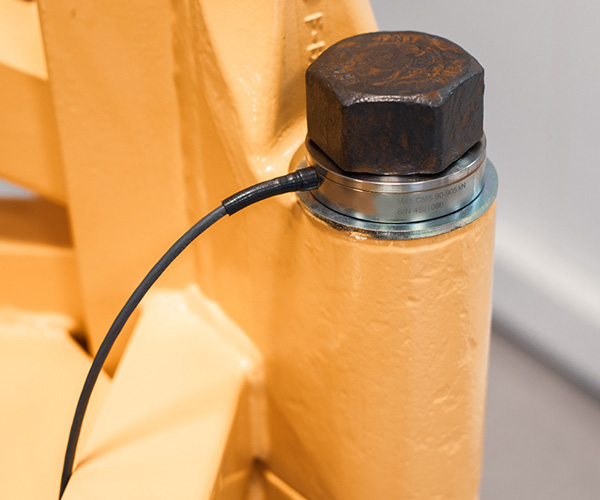
The deployment of a bolt load cell involves strategically positioning it on the non-driven side of a bolted connection, preferably beneath a nut. As the bolt is tightened, force is exerted onto the load washer, inducing minimal deformation in the stainless steel washer. This deformation is continuously measured by the sensor, which gauges changes in electrical resistance. This dynamic data is then utilized to ascertain the real-time bolt load at any given instance.
There are two distinct types of bolt load cells available, tailored to specific monitoring needs:
Continuous Monitoring Sensors (CMS) : These sensors are designed for ongoing, uninterrupted monitoring, providing a continuous stream of data for comprehensive insights.
Periodic Monitoring Sensors (PMS) : Tailored for periodic assessments, these sensors offer intermittent monitoring, suitable for specific scenarios requiring periodic bolt load evaluations.
A variety of readout methods are at your disposal for monitoring bolt load data, ensuring flexibility and compatibility with diverse operational requirements. This comprehensive suite of bolt load cell solutions empowers engineers and industry professionals with a sophisticated and reliable means of overseeing bolted joints, fostering a heightened level of control, reliability, and safety in critical applications.
Why choose a CMS bolt load cell ?
The specialized bolt load cell is meticulously engineered to track the actual bolt load within bolted joints. It offers uninterrupted monitoring of bolt load from a single connection point, with the flexibility to interconnect multiple load sensors within a network. The adoption of load cells eliminates uncertainties surrounding bolt load, paving the way for heightened safety, steadfast joints, and improved structural control.
Beyond the safety enhancements, the deployment of load cells results in reduced costs during both installation and the service life of the joint. Each sensor is equipped with an Application Specific Integrated Circuit (ASIC), which handles signal conditioning and digital communication. This unique feature assigns an individual serial number to each load sensor, ensuring distinct identification and traceability. The digital monitoring system not only quantifies bolt load but also monitors the sensor temperature.
These load cells find application in temporary construction and Structural Health Monitoring, where they serve as washers to assess the load in the construction, ensuring the integrity of (temporary) structures to prevent any risk of collapse. This comprehensive solution offers a sophisticated and reliable means of monitoring bolt load, contributing to enhanced safety, operational efficiency, and cost-effectiveness in critical applications.
How CMS is it employed ?
The bolt load cell, designed in the configuration of a standard washer, is available across sizes ranging from M10 to M62 approximately. Positioned on the non-driven side of a bolted connection, ideally beneath a nut, the bolt load cell operates seamlessly. During the bolt-tightening process, force is exerted onto the load washer, inducing slight deformation in the stainless steel washer. The sensor continually gauges alterations in electrical resistance resulting from these deformations, facilitating the determination of the actual bolt load at any given moment.
Distinguished by a robust design, the load cells exhibit resilience against challenging conditions prevalent in heavy industrial environments. The load sensors are compatible with contact with oil, exposure to rain, seawater, ice, and temperatures reaching up to 70 degrees Celsius. However, it is advisable to refrain from utilizing the washers in environments where temperatures exceed 65 degrees Celsius or drop below -30 degrees Celsius.
The sensor calibration is a one-time procedure, rendering the sensor plug-and-play. No recalibration is required when employing different readout methods.
Advantages of a Continuous Monitoring Load Cell
Continuous monitoring of bolt load offers significant advantages, simplifying the real-time determination of the bolt load while the load cell is in place. Beyond instantaneous load assessment, the ability to access historical data is a valuable feature. This historical perspective aids in pinpointing when and where any issues related to the bolt load might have arisen.
Moreover, load cell boasts the advantage of network connectivity. It can be seamlessly integrated with other load cells, forming a network where data from all sensors can be collectively monitored. This interconnected system facilitates the simultaneous observation of live data from multiple bolt load cells, allowing for remote checks through various readout methods. The versatility and comprehensive data accessibility make the load cell an efficient and reliable tool for continuous monitoring applications.
How the PMS Bolt Load Cell Functions
The PMS bolt load cell is a specialized load sensor designed for monitoring the actual bolt load in bolted joints. PMS, or Periodic Monitoring System, enables the monitoring of the bolt load when a handheld reader and a probe are employed. Notably, PMS load sensors feature a non-contacting interface, eliminating the need for a cable connection. While in service, the unit is powered through an inductive interface linked to a handheld instrument. Direct monitoring of the bolt load can be carried out on the handheld reader using a probe.
Employing a load cell eradicates uncertainties regarding the bolt load, contributing to heightened safety, enhanced control over structures, and more dependable joints. Beyond safety advantages, there is also a reduction in costs during installation and throughout the joint’s service life.
Each sensor incorporates an Integrated Circuit, managing all signal conditioning and digital communication. This ensures that each load cell possesses a unique serial number for individual identification and traceability. The digital monitoring system not only measures the bolt load but also monitors the sensor’s temperature. The load cell is available in various types of steel, including regular stainless steel and a stronger version capable of withstanding higher loads while maintaining compact dimensions.
How the PMS is utilized ?
The PMS bolt load cell is employed as a regular washer and is available in sizes approximately ranging from M35 to M60. Placed on the non-driven side of a bolted connection, preferably under a nut, the bolt load sensor functions during the tightening process. As force is applied to the load washer, there is a minor deformation of the stainless steel washer. The sensor continually measures changes in electrical resistance resulting from these deformations, facilitating the determination of the bolt load at any given moment.
Thanks to their robust design, load cells demonstrate resilience in challenging conditions, making them suitable for heavy industrial environments. They can be utilized in contact with oil, rain, seawater, ice, and are effective within temperatures reaching up to 75 degrees Celsius.
Following the one-time calibration of the sensor, there is no need for recalibration throughout the load cells’ service life, even when employing different readout methods. This holds true as long as the load cells are utilized according to their specified specifications and requirements.
Advantages of a PMS
PMS load cells offer distinct advantages, particularly in situations where small spaces limit cable usage. The PMS washer excels in compact spaces as it doesn’t necessitate a cable connection. With PMS bolt load cells, readings can be obtained without any cable connections using a probe. Users have the convenience of directly monitoring the actual bolt load on the handheld reader. This feature allows for a swift readout of multiple sensors with the same reader consecutively. The data from numerous load cells can be stored on the handheld reader and subsequently transferred to a computer for further analysis.
What is a Through Hole Load Cell (THLC)?
A through hole load cell, also referred to as a thru hole load cell, is a specialized force transducer employed for the measurement of forces such as tension, compression, torque, and pressure. The distinctive feature of a through hole load cell is the presence of a central aperture, from which it derives its name. These cells effectively convert applied forces into electrical signals, allowing for precise measurement and standardization. Users can then read and record the obtained data.
The electrical signals produced by through hole load cells vary proportionally with the forces exerted on the sensors. Several types of through hole load cells are available in the market, each employing different internal mechanisms. Strain gauges, piezoelectric cells, hydraulic cells, and pneumatic cells are among the most commonly used technologies. Through hole load cells can accommodate a range of forces, including tension, torque, compression, and pressure. Widely utilized across various industries, these load cells fulfill the need for accurate and precise measurements of weight and other forces.
The distinctive “through hole” configuration offers a particular advantage, allowing the load cell to be placed around a bolt, facilitating the measurement of bolt load. This unique feature makes through hole load cells especially well-suited for applications requiring precise bolt load measurements.

How does the THLC Operate ?
Through hole load cells are purposefully engineered to measure and monitor bolt load in bolted constructions, both during assembly and over an extended period. Acquiring this information not only enhances safety and control but also ensures the reliability of joints within the construction. The through hole load sensor is strategically positioned on the non-driven side of a bolted connection, ideally beneath a nut. The act of tightening the bolt subjects the through hole load cell to forces, inducing slight deformations in the stainless steel washer.
These deformations lead to changes in electrical resistance, a phenomenon accurately measured through magnetoelastic technology. The acquired data enables us to precisely determine the bolt load at any given moment. This sophisticated process empowers engineers with real-time insights into the forces applied to bolted connections, contributing to improved construction management, heightened safety standards, and the dependability of joints within the structure.
The Advantages of Through Hole Load Cells
Employing cutting-edge magnetoelastic technology, our through hole load cells boast superior compactness and cost-effectiveness when compared to alternative technologies like strain gauges or piezoelectric methods. Unlike conventional approaches that measure load at a few pressure points, our load cells ensure precise measurement across the entire surface of the ring, enhancing accuracy.
Internal calibration eliminates the need for (re)calibration at the end of the readout equipment, even when transitioning between different readout methods. Load cells are compatible with a broad range of loads, spanning from 30 kN to 2000 kN, emitting only digital signals.
Featuring minimal creep effect and being drift-free, through hole load cells guarantee a maximum deviation of 5% of the full scale following factory calibration. They meet the stringent IP66 rating, ensuring resistance to dust and water. Here diverse readout methods tailored to accommodate a variety of preferences, scenarios, and applications.Few manufacturers and suppliers of bolt load cell technology
In the realm of precision fastening solutions, several companies stand out as leaders in the design and sale of bolt load cells, offering cutting-edge technologies to meet the diverse needs of industries worldwide. Here’s a glimpse into five prominent players in this field:
BoltSafe: BoltSafe specializes in advanced bolt load cell solutions, providing robust and dependable devices for measuring and monitoring bolt loads. Their sensors, available in various steel options, leverage sophisticated ASIC technology for precise signal conditioning and digital communication, ensuring accurate and traceable measurements.
Loadcell Supplies: Loadcell Supplies is a key player in the development and distribution of load cell solutions, including those tailored for bolt tensioning. Their comprehensive range of load cells caters to various load capacities, offering reliability and durability for critical applications in industries such as construction, manufacturing, and infrastructure.
Applied Measurements: Applied Measurements is recognized for its innovative load cell technologies, including those designed for bolt tensioning applications. Their through hole load cells, utilizing magnetoelastic technology, provide compact and cost-effective solutions with precise load measurement across the entire surface, meeting the demands of diverse industries.
Strainsert: Strainsert has been a prominent player in force sensing technology for over 40 years, providing a range of bolt load cells for critical applications. Their load cells are known for their robust construction and high accuracy, ensuring reliable performance in challenging environments across industries such as aerospace, defense, and industrial manufacturing.
These companies, through their commitment to technological innovation and precision engineering, contribute significantly to the advancement of bolt tensioning solutions globally. Each brings a unique set of capabilities and expertise, collectively shaping the landscape of bolt load cell technology.
Disadvantages of Bolt Load Measurement with Load Cell
High Initial Cost: While load cells offer unparalleled accuracy, their initial cost can be higher compared to other bolt tension measurement methods, potentially influencing adoption decisions.
Sensitivity to Environmental Conditions: Some types of load cells may be sensitive to temperature variations and other environmental conditions. This sensitivity sometimes requires corrective measures to maintain measurement reliability.
Frequent Calibration: Regular calibration is often necessary to ensure constant measurement accuracy. This can lead to additional costs and time requirements, potentially impacting operational efficiency.
Complex Installation: Compared to other bolt tension measurement methods, the installation and integration of load cells can be more complex. This requires technical expertise and may extend the time needed to set up the measurement system.
Power Dependency: Some types of load cells may require continuous power. This power dependency can introduce potential complications, especially in environments where a constant power supply is not guaranteed.
Modification of Structure during Installation: The presence of a load cell can modify the structure of the assembly during its installation, requiring additional assessment to ensure the integrity of the modified assembly.
Advantages of ultrasonic bolt tension Meter over bolt Load Cells
Non-Intrusive Measurement: Unlike bolt load cells that may alter the assembly structure during installation, TRAXX-M2 uses ultrasonic technology for non-intrusive measurement, preserving the integrity of the assembly.
Precision without Calibration: TRAXX-M2 eliminates the need for frequent calibration, ensuring precision in bolt tension measurements without the ongoing calibration requirements associated with some load cells.
Environmental Robustness: TRAXX-M2 is less sensitive to environmental conditions, providing reliable measurements in varying temperatures and environmental settings without requiring additional corrective measures.
Simplified Installation: The ultrasonic bolt tension meter offers a simpler installation process compared to certain load cell systems, reducing complexity and allowing for quicker implementation, saving both time and resources.
Cost-Effective Solution: TRAXX-M2 presents a cost-effective solution with competitive initial costs, making it an attractive option for those seeking accurate bolt tension measurements without the potentially higher upfront investment of certain load cell technologies.
Designed for industrial on-site applications : TRAXX-M2 is a portable solution with a weight of just 3 kg, making it easy to transport and handle during various applications. It boasts robustness with an IP64 rating, ensuring protection against dust and water ingress, and is shock-resistant to withstand challenging industrial environments. Featuring an ergonomic design, the ultrasonic bolt tension meter TRAXX-M2 comes equipped with a touchscreen and an intuitive interface, enhancing user experience and making the operation more user-friendly.
High performance on all threaded screws/rods : TRAXX-M2 is compatible with a variety of screws, accommodating both raw and unmachined screw types. It supports a broad range of lengths, spanning from 5 mm to an impressive 14 m. Additionally, the Traxx-M2 is designed to handle screws with diameters ranging from 2 mm to 500 mm.
Measurement precision can reach 1% : The bolt tension meter TRAXX-M2 provides bolt elongation measurements expressed in kilonewtons (kN), ensuring precise and reliable data for the tightening process. Temperature correction is seamlessly integrated into the measurements, enhancing accuracy across varying temperature conditions. Employing a non-intrusive method, the Traxx-M2 ensures that measurements do not alter the nature of the assembly, maintaining the integrity of the entire system.