Table of contents
By locally heating the tightening area, the material becomes more malleable, allowing for precise fitting. This technique is commonly employed in the automotive industry for assembling components such as bearings onto shafts. Precise control of temperature and heating time is crucial to ensure effective tightening without altering the material properties.
The theoretical basis of Induction Bolt Heating : thermal expansion
If you aim to master controlled tightening using the bolt heat induction method, seek a steel expansion calculator, or want to understand the expansion factor of aluminum based on temperature, it’s essential to comprehend the theoretical foundation of induction bolt heating. Firstly, heating a material leads to its expansion. The elongation ΔL is proportional to the initial length L0 and the temperature rise ΔT. Each material has its own proportionality factor α. The equation
ΔL = α . L0 . ΔT
represents the linear thermal expansion, where:
• ΔL is the change in length,
• α is the coefficient of linear expansion,
• L0 is the initial length,
• ΔT is the change in temperature.
The unit of the coefficient of linear expansion (α) is expressed as follows:
• α, the coefficient of linear expansion, is measured in inverse kelvin (K^(-1)).
• L0, the initial length, is measured in meters (m).
• ΔT, the change in temperature, can be measured either in kelvin (K) or in degrees Celsius (°C).
Induction Bolt Heating : thermal expansion properties of materials
Expanding on this concept, understanding the thermal expansion properties of materials is crucial for effective induction bolt heating. Different materials exhibit varying responses to temperature changes, and the choice of material and its properties play a significant role in the success of the induction bolt heating process.
Controlling bolt heat induction process requires precise knowledge of the temperature rise needed for the desired expansion, the material’s specific heat capacity, and the time required for the heating process. This information ensures that the induction heating achieves the optimal thermal expansion for efficient and accurate tightening.
In summary, mastering induction bolt heating involves not only understanding the theoretical principles but also considering the specific characteristics of the materials involved and implementing precise temperature and heating time controls for successful and reliable tightening applications.
Calculation of Thermal Expansion for Bolts
Are you in need of calculating the thermal expansion of your bolts or studs? Here, we present a method for simulating thermal expansion.
Utilize this calculator to convert thermal expansion into mechanical stress for your bolts. This simulator allows you to deduce whether your bolt has reached its elastic limit based on temperature.

The principle of Induction Bolt heating
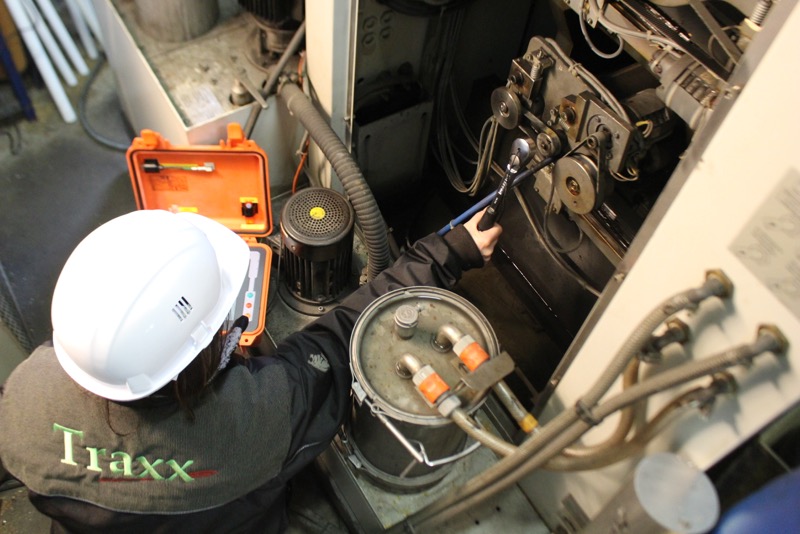
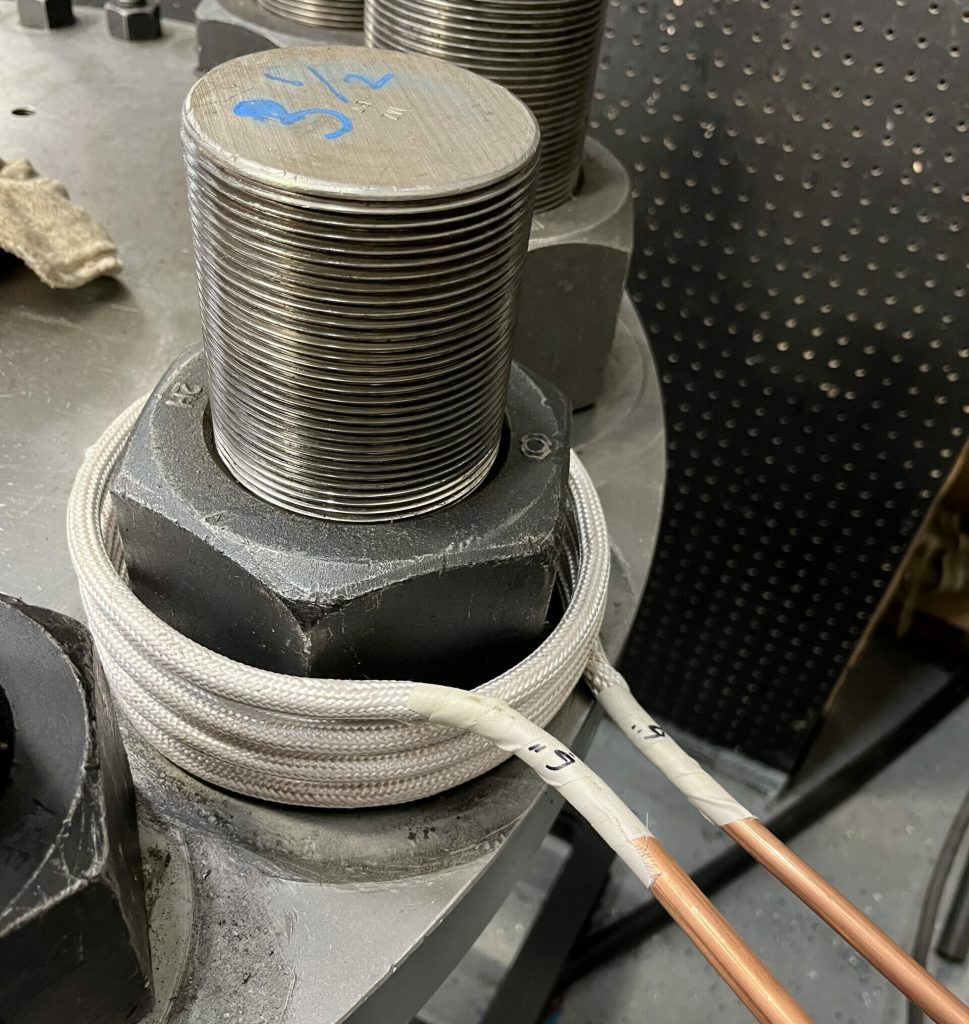
The principle of bolt heating is achieved by creating an electromagnetic field that facilitates a heat exchange, inducing an expansion in the bolt or rod.
After manually tightening the nut to the optimal angular value, tension within the bolt or rod is generated during the cooling process with a bolt heat induction tool as a induction bolt heater.
Hot bolting of bolts is predominantly carried out using induction heater for bolts.
Advantages of Induction Bolt heating for Tightening
Induction bolt tightening, utilizing thermal expansion, brings forth numerous advantages:
1. Deep Heating for Core Material: Induction excels in heating the core of steel, reducing heating time and limiting the risk of part rupture.
2. Efficiency and Speed: The induction method ensures swift and fluid bolt-to-bolt transitions, facilitating a quicker tightening process. The heating element and nut remain cool, allowing manual tightening without gloves and requiring only one operator per machine.
3. Time Savings: Induction leads to time savings in both heating and cooling phases, streamlining the overall tightening or loosening process.
4. Torsional Stress Elimination: This method eliminates torsional stress in both bolts and rods, contributing to the longevity of the assembly.
5. Temperature Difference: On average, the temperature difference between a bolt heated by induction and one heated using traditional methods is around 90°C.
6. Mobility and Integration: Induction machines are often mobile, equipped with integrated cooling systems that eliminate the need for water connections. They operate efficiently with a single electrical outlet.
Limitations of Induction Bolt Tightening in Engineering Applications
While Induction Bolt heating for tightening has gained significance for achieving precise and controlled tightening in engineering applications, engineers must consider its limitations:
- Material Sensitivity: Induction tightening is sensitive to material variations, posing challenges when dealing with materials exhibiting diverse properties. Inconsistencies may arise, especially when working with materials of variable properties.
- Temperature Effects: The heat generated during the induction process can adversely affect surrounding components. In temperature-sensitive applications or with materials prone to heat-induced deformation, engineers must carefully evaluate the thermal implications and potential damage to adjacent components.
- Initial Cost and Complexity: The establishment of induction tightening systems often requires a substantial initial investment in specialized equipment and technology. The complexity of induction tightening devices, including the need for precision control and monitoring systems, may escalate overall costs. Small to medium-sized projects may find it challenging to justify the expenses associated with adopting induction tightening technology.
- Maintenance and Calibration: Systems of this nature demand regular maintenance and calibration to ensure consistent and accurate performance. The complexity of these systems, coupled with the need for specialized knowledge, can lead to increased downtime and operational costs. Engineers must factor in ongoing maintenance requirements when assessing the long-term viability of this solution.
- Environmental Considerations: The induction tightening process typically involves electrical energy consumption, contributing to an increased environmental footprint. Engineers must carefully weigh energy consumption, electromagnetic emissions, and the disposal of used components as important environmental considerations when opting for induction tightening methods.
Considerations about bolt heat induction
Since the early 1990s, induction bolt heating has emerged as a good method for efficiently handling large bolts and fasteners. Despite its success, several misconceptions have arisen over the years. Some articles erroneously suggested the involvement of sound waves, and concerns were raised about thread damage during disassembly. Users also expressed worries about magnetic fields and “microwaves.”
Interestingly, even with bolts on turbine shells enduring temperatures of 600-800 degrees F for seven years, metallurgical damage remains a non-issue.
In simple terms, envision the process using a transformer analogy. An induction coil placed within the bolt’s bore acts as the primary winding of a transformer. The alternating magnetic field produced by the inductor induces electricity within the bolt, creating an effect similar to a dead short on the secondary of a transformer. This results in the dissipation of 100% of the induced energy in the form of heat.
A more intricate explanation involves a profound understanding of induction coil construction, the use of flux concentrators, and the specific distance from the coil conductor to the part being heated. This requires comprehensive knowledge of the magnetic fields produced, the impact of frequency on these fields, and how to effectively couple this with an induction power supply. Harmoniously executed, this enhances efficiency, leading to reduced heating times. Remarkably, 2″ diameter bolts with a ½” bore and 24″ in length can be heated in less than 30 seconds with certain machines, while a 50” long, 8” diameter bolt with a 7/8 bore can be heated in just 5 minutes.
Machine sizing is contingent upon the intended bolt sizes and materials. We recommend a minimum machine power of 60 kW for the power generation industry, where smaller turbines have bolts ranging from 2″ to 5″ in diameter. In cases where a lesser-powered machine matches the time taken by traditional heating methods, the time-saving advantages of induction heating are nullified.
In certain scenarios, especially with newer gas turbines or nuclear-sized turbines, the need for an adaptable machine up to 130 kW is recommended. The machine’s running frequency plays a crucial role in inductor sizing, with a range between 7 kHz and 13 kHz. This range allows for a greater mismatch between the bore and inductor while ensuring efficient coupling to the parts being heated. It also facilitates the use of slightly longer or shorter heated lengths without compromising heating times.
Ideal setting for bolt heating
In an ideal setting, bolt heating would focus solely on the region between the clamping surfaces, such as between the two nuts of a turbine or flange bolt. However, practical considerations make it impractical to stock and carry inductors for every different length.
The time required to change from one inductor to the next for minor length differences may be longer than the loss in heating time for a slightly mismatched bore inductor combination. This consideration assumes that the machine operates in the lower frequency ranges. As the frequency range increases, especially with lower-powered machines, precision in bore-to-inductor matching becomes more critical. This may elevate costs and extend job completion times due to the necessity for more inductor sizes and changes.
Regarding bolting patterns, a general rule for turbines is to start in the center of each side of the turbine shell and work towards each end. While certain manufacturers or site-specific conditions might dictate variations in bolting patterns, the typical approach for bolt heating is from the center out.