Table of contents
Bolt Load After Temp Change: Understanding Thermal Effects on Bolted Joints
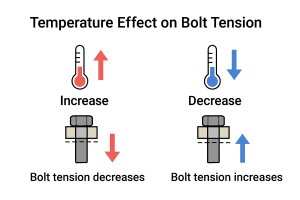
Bolted joints are critical elements in engineering applications, from aerospace and automotive to energy and railway sectors. The preload applied to a bolt ensures the structural integrity of the assembly. However, temperature changes can significantly affect bolt load. When a bolted assembly is heated or cooled, the bolt and clamped components expand or contract at different rates, depending on their material properties, dimensions, and thermal conductivity. This differential expansion can either increase or decrease the bolt preload, potentially leading to joint loosening, overloading, leakage, or even structural failure.
Consequences of bolt load after temp change :
Temperature not only affects elastic elongation but can also trigger creep, relaxation, and changes in friction. These effects are particularly pronounced at high service temperatures (above ~250°C) and during transient thermal states, such as engine start-up, turbine ramp-up, or rapid heating/cooling cycles. Engineers must understand and anticipate these thermal impacts to maintain safe and reliable bolted assemblies.
Physical mechanisms affecting bolt load after temp change
Differential Thermal Expansion
All materials expand or contract with temperature changes, but each material has its own coefficient of thermal expansion (α). In bolted assemblies, when the bolt, nut, and clamped parts have different α, temperature changes result in variations in bolt preload.
The approximate change in preload ΔF due to a temperature change ΔT can be expressed as:
ΔF=E⋅A⋅(α bolt−α part)⋅ΔT
Where:
E = Young’s modulus of the bolt material
A = cross-sectional area of the bolt
α bolt, α part = thermal expansion coefficients of bolt and clamped parts
ΔT = temperature change
A bolt with a smaller expansion coefficient than the clamped part will lose preload when heated, and vice versa.
Thermal Relaxation and Creep
At service temperatures above 250°C, creep and relaxation phenomena occur in alloyed and construction steels. Even if bolts are preloaded elastically at the service temperature, a portion of the preload relaxes proportionally to the reduction in yield strength of the steel fastener.
Creep deformation ϵ can be modeled using the Norton-Bailey law:
ϵ=A⋅σ^n⋅(e^−Q/(RT))
Where:
ϵ= creep strain
A,n,Q = material-specific constants
σ = applied stress
R = gas constant
T = absolute temperature
This deformation gradually reduces bolt tension, potentially causing partial loosening of the joint
Friction Variation
Temperature affects the friction coefficient between the bolt, nut, and contact surfaces. Lower friction at high temperatures can unintentionally increase preload for a given torque, while higher friction may reduce torque transfer. Torque-based tightening alone is often unreliable under varying thermal conditions.
Negative effects of bolt load after temp change
Temperature fluctuations cause bolts and parts to expand or contract at different rates, depending on temperature change speed, mass, part size, metal conductivity, and individual material expansion coefficients. These differences create preload variations, often peaking during transient temperature states.
Thermal cycling can also induce thermally-induced fatigue, as not all regions expand uniformly. Boundaries between “hot” and “cold” areas experience extra stress, potentially causing localized fatigue. To minimize preload variations, engineers should:
Select materials with homogeneous expansion coefficients
Account for preload loss due to creep and relaxation
Follow modern design codes and joint-calculation guidelines, including evaluating mechanical property changes at service temperature, such as aging, precipitation, or heat treatment effects
Ensure that thermal expansion differences do not induce excessive stress in the joint during service cycles

Mathematical Model for bolt load after temperature change
The final bolt load F final after a temperature change can be estimated by combining thermal expansion, creep, and friction effects:
F final=F0+E⋅A⋅(αbolt−αpart)⋅ΔT−ΔFcreep
F0 = initial preload
E = Young’s modulus of the bolt
A = bolt cross-sectional area
αbolt,αpart = thermal expansion coefficients
ΔT= temperature change
ΔFcreep = preload loss due to creep and relaxation
Example Application
Consider a steel bolt with:
F0=50 kN (initial preload)
E=210 000 MPa
A=200 mm²
αbolt=12×10^−6 /°C
αpart=18×10^−6/°C
If the assembly experiences a temperature increase of ΔT=100°C and a creep-induced preload loss of ΔFcreep=2 kN, the final bolt load can be estimated as:
ΔFthermal=210 000⋅200×10−6⋅(−6×10−6)⋅100=−25.2kN
Ffinal=50−25.2−2=22.8 kN
Interpretation: The bolt loses more than half of its initial preload due to thermal expansion differences and creep, highlighting the importance of proper material selection, joint design, and preload measurement.
Sector Applications
Aerospace: Engines and airframe components experience extreme thermal changes. Preload loss can compromise critical assembly safety.
Energy: Thermal cycles in power plants or nuclear facilities increase the risk of leakages or structural failures if bolts relax excessively.
Automotive: Engines undergo rapid heating and cooling cycles. Accurate bolt preload prevents gasket failures or component deformation.
Railway: Rails and mechanical components are exposed to environmental and braking-induced thermal variations. Preload loss affects stability and safety.
Measuring and Compensating Bolt Preload with Temperature Variations: TRAXX M2
The TRAXX M2 ultrasonic bolt tension meter directly measures bolt elongation and calculates preload independent of torque. One of its key advantages is handling temperature variations, which are critical because:
Temperature changes alter both the mechanical length of the bolt and the ultrasonic wave propagation velocity.
Even small variations of a few degrees can introduce 10–20% errors in tension measurement.
How TRAXX M2 Compensates for Temperature :
Preliminary Temperature Calibration: The system determines the variation of ultrasonic length per °C (ns/°C) as a function of temperature.
Linear Relationship: The calibration reveals a nearly linear relationship, defining the temperature coefficient (β) for the assembly.
Temperature Probe Integration: During measurement, the system reads the bolt temperature and automatically applies the corresponding correction.
Length Reset to Initial Temperature: The measured ultrasonic length is adjusted to the temperature of the initial reference measurement, effectively eliminating temperature-induced errors.
Tension Calculation: The corrected length is used to compute the preload, ensuring accuracy within ±3% despite temperature fluctuations.
This approach allows engineers to monitor bolt load after temp change reliably, even in challenging thermal environments.

Conclusion on bolt load after temp change
Temperature variations have a major impact on bolt preload due to differential expansion, creep, relaxation, friction changes, and transient thermal effects. Mathematical modeling combined with advanced measurement solutions, like the TRAXX M2, allows engineers to accurately monitor and compensate bolt load after temp change, ensuring joint integrity, safety, and long-term performance across aerospace, automotive, energy, and railway applications.