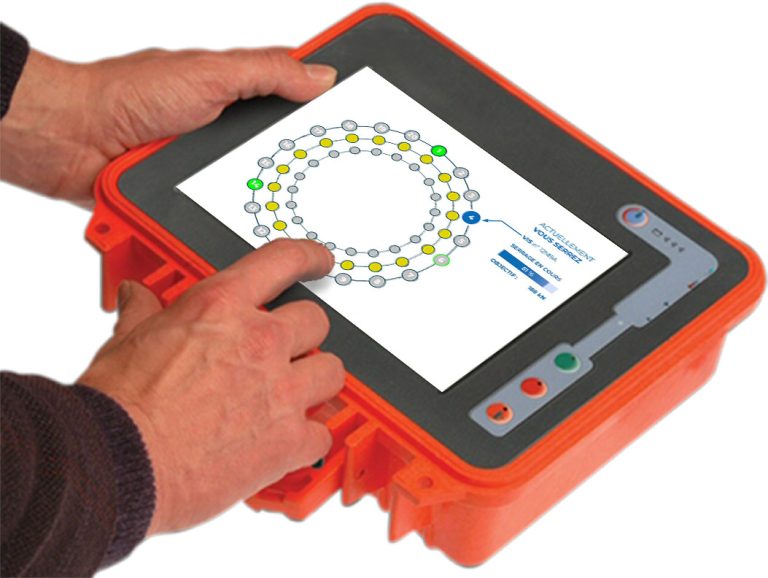
Exploration of opportunities offered by bolt load measurement and tensioning in industry
In high-performance industries such as energy, aerospace, and transportation, accurate bolt tension is critical. A single improperly tightened bolt can compromise an entire structure. That’s why knowing how to measure bolt stretch—and doing it correctly—is more than good practice; it’s essential.
In this guide, you’ll learn about the four key steps in bolt tension measurement using ultrasonic technology, the influence of temperature, and the tools required to ensure precision at every stage. Whether you’re a field technician, maintenance engineer, or quality manager, this article will help you better understand and control your bolted joints.
🔩 What Does “Measuring Bolt Stretch” Actually Mean?
Bolt stretch refers to the elongation of a bolt as it is tightened. When a bolt is torqued, it stretches under tension. This elongation is proportional to the clamping force—the very force that keeps an assembly together.
While traditional tightening methods rely on torque (which can be inaccurate due to friction), ultrasonic measurement of bolt stretch provides a direct, reliable method to assess the true preload inside the bolt. That’s why learning how to measure bolt stretch accurately is critical to industrial safety and performance.

📐 Step 1: Preliminary Characterization of the Assembly
The first and most important step in how to measure bolt stretch is to perform a preliminary characterization of the bolt and assembly.
🧪 What is Characterization?
A sample bolt identical to those used in the actual assembly is placed in a tensile testing machine. This machine applies controlled loads (tension), and for each load level, the ultrasonic Time of Flight (ToF) is recorded using a device such as the TRAXX-M2.
The result? A coefficient of proportionality K, which links ToF (measured in nanoseconds) to the actual bolt tension (measured in kN or daN).
📊 The Formula:
Tension (kN) = K × Ultrasonic Elongation (ns)
This calibration only needs to be performed once per bolt type and length. From there, the TRAXX system uses this data to deliver precise, repeatable measurements across any number of bolts in that assembly type.


🛠 Step 2: Measuring the Initial Bolt Condition On-Site
Now that the system understands how a bolt behaves under load, it’s time to take the process into the field.
Each bolt is scanned before tightening using an ultrasonic transducer. This captures the initial ultrasonic length—a digital fingerprint of the bolt at rest.
These measurements are stored in the TRAXX-M2 database, ensuring that each bolt is tracked and referenced individually.
🔧 Step 3: Tightening the Bolt and Measuring the Final Stretch
Once the bolts are torqued, the operator repeats the ultrasonic measurement to record the final ToF—the new length after tension has been applied.
The system compares the initial and final ultrasonic readings, calculates the elongation, and uses the predefined K coefficient to determine the exact bolt tension.
✅ If the target tension is achieved: the final state is recorded and validated.
❌ If the tension is too low or too high: the bolt can be re-tightened or adjusted.
This feedback loop ensures 100% quality control on each bolted joint.
🔄 Step 4: Ongoing Monitoring and Predictive Maintenance
One of the major advantages of ultrasonic bolt tension systems like TRAXX is the ability to perform non-invasive monitoring over time.
Technicians can revisit the assembly and re-measure bolt elongation without disassembly. This enables proactive maintenance by detecting:
Loss of tension
Creep or relaxation in the joint
Early signs of fatigue
In essence, learning how to measure bolt stretch opens the door to predictive maintenance strategies—saving time, cost, and reducing the risk of unexpected failure.

🌡 How Temperature Affects Bolt Stretch Measurement
It’s important to know that temperature has a significant influence on ultrasonic measurements. Heat affects both the physical length of the bolt and the speed of ultrasonic wave propagation.
🔥 A few degrees = big errors
Even small temperature variations can lead to 5–10% errors in tension measurement. This is particularly important when bolts are measured at a different temperature than when they were initially tightened.
📉 The Solution: Temperature Compensation
TRAXX systems incorporate a temperature coefficient ß, determined during a thermal characterization. With an onboard temperature probe, the system can:
Adjust final readings back to the original measurement temperature
Apply automatic corrections for reliable tension values in any environment
This ensures that your bolt stretch measurements are accurate regardless of ambient conditions.
🧰 What Equipment Is Used to Measure Bolt Stretch?
Learning how to measure bolt stretch also involves choosing the right equipment:
⚙️ Tensile Testing Machines (for characterization)
Hydraulic models: for high-force calibration (used in energy and aerospace)
Electromechanical machines: ideal for lab environments and R&D
Portable test rigs: for quick, on-site assessments
🔍 Ultrasonic Measurement Systems
TRAXX-M2: measures bolt elongation with ultrasonic transducers
Captures both initial and final ToF values
Tracks each bolt and logs data for traceability
🌡 Temperature Sensors
Essential for automatic compensation
Integrated into the TRAXX measurement workflow
📈 Final Thoughts: How to Measure Bolt Stretch the Right Way
Knowing how to measure bolt stretch is not just a technical skill—it’s a strategic advantage. Whether you’re assembling high-stakes infrastructure or maintaining critical assets, ultrasonic bolt tension measurement ensures:
Better structural integrity
Fewer maintenance issues
Improved safety and compliance
By following the four-step method—characterization, initial scan, tightening, and monitoring—your teams can take control of joint performance with unmatched precision.
📞 Want to Learn More or Book a Demo?
📧 Contact us at: Traxx@Traxx-group.com
Discover how ultrasonic bolt tension measurement can optimize your operations—one bolt at a time.