
Bolt loosening: a problem inherited from the industrial revolution
Almost every engineering product with any level of complexity utilizes threaded fasteners. One of the main advantages of threaded fasteners over other joining methods is their ability to be disassembled and reused. However, this benefit can also lead to problems, as these fasteners can self-loosen. This issue has been a challenge since the beginning of the industrial revolution, and for the past 150 years, inventors have been working on solutions to prevent it.
Accidents caused by fastener loosening occur across various industries, with some having severe consequences.
Self-loosening of bolts: the state of the art
The most influential research on this topic was conducted by Gerhard Junker in 1969. Junker developed a theory explaining why fasteners tend to self-loosen under vibratory loads. He discovered that transverse dynamic loads create a much more severe condition for self-loosening compared to dynamic axial loads.
Why is there self-loosening of bolts?
Preloaded fasteners can self-loosen when there is relative movement between the mating threads and the fastener’s bearing surface. This movement happens when the transverse force acting on the joint exceeds the frictional resistance generated by the bolt’s preload. Repeated transverse movements can cause the fasteners to become completely loose.
Testing for self-loosening
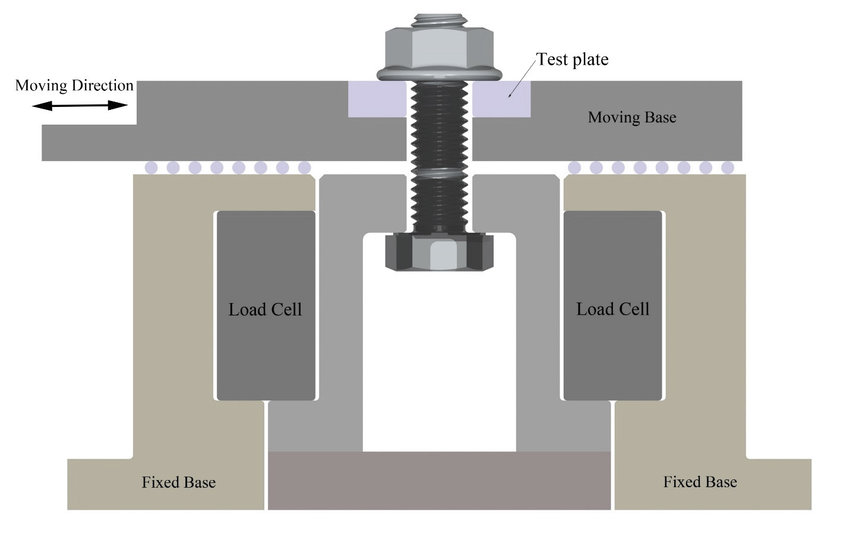
Junker developed a test machine to examine the impact of transverse movement on preloaded threaded fasteners. This machine applies cyclic transverse displacement to a bolted joint. It features a load cell within the joint that continuously monitors the bolt load as transverse motion is applied. This type of test machine is standard for studying the self-loosening process. This test machine monitors bolt loosening due to vibration.
Prevailing torque nuts
Prevailing torque nuts are often used to prevent the complete loosening of bolted assemblies. There are many types of prevailing torque nuts available. While increasing the prevailing torque improves resistance to self-loosening, it also increases the torsional stress due to frictional drag on the threads.
Certain so-called locking devices have proven to be entirely ineffective at preventing loosening. For instance, using a helical spring washer under a bolt head can actually cause the bolt to loosen more quickly than if it were used on its own.
Relaxation and bolt loosening
Self-loosening occurs when a fastener rotates due to external loading. Non-rotational loosening happens when there is no relative movement between the internal and external threads, but preload is lost. When preload loss occurs without movement of the fastener, the term relaxation is used.
Relaxation involves local plastic deformation beneath the nut face, within the joint faces, and in the threads, caused by plastic flattening of the surface roughness. This can happen even if the loading is below the yield point of the bolt or the material’s limiting surface pressure, and it results from the actual contact area between surfaces being smaller than the apparent area.
In practice, the loosening of nuts and bolts often results from a combination of relaxation, which reduces preload and allows joint movement. Once movement starts, the fastener or joint typically fails due to self-loosening or fatigue.

How to keep bolts from loosening thanks to ultrasonic bolt load measurement?
Unlike torque tightening, tension measurement provides the precision and reliability needed to ensure an optimal assembly and prevent relaxation. This method helps avoid potential failures between components and ensures the reliability of the assemblies.
Traditional methods, such as using load cells or strain gauges, are intrusive and not well-suited for industrial site use. Additionally, so-called “smart” bolts (with permanent sensors embedded in the bolt head) require costly and unnecessary operations. TRAXX offers an innovative alternative: an ultrasonic measurement system that ensures precise tightening without altering the nature of the bolts or the assembly.
What are the benefits of bolt load measurement?
TRAXX’s approach revolutionizes the tensioning market by offering an integrated method that combines bolt tightening with measurement. This approach provides significant advantages, including 3 to 5% accuracy in tightening tension, without requiring major modifications to the assembly. Prestigious clients such as STELLANTIS, FERRARI, ALSTOM, EDF, GE, and AIRBUS attest to the effectiveness of this method.
TRAXX’s practical applications are diverse and extensive. For example, the company recently managed the tightening and monitoring of a new gas turbine assembly at GE, enabling early detection of potential anomalies. Similarly, TRAXX collaborates with CLAAS for endurance testing of tractor chassis bolts, offering real-time monitoring and identification of risk points. In summary, TRAXX can ensure precise tightening on both tractors and fighter jets like the Rafale.