Table of contents
Torque audit : how to perform one on a bolted joint ?
A survey conducted in the United States among automotive industry service managers revealed that 23% of problems encountered were due to loose fasteners and that 12% of new cars had loose fasteners. The information and techniques presented below are intended to help engineers ensure that their threaded fasteners are tightened to the desired preload.
An introduction to torque audit
The constant pursuit of better quality in fastened assemblies in the industry has impacted the evaluation of torque measurement on assembly lines. Simply tightening a nut until it stops, hoping it is tight enough, is no longer sufficient. Bolted assemblies can be a concern for engineers. A single poorly tightened bolt can lead to the failure of the entire assembly. Excessive torque can risk damaging the bolt shaft or threading, while insufficient torque results in inadequate tension. Failure to meet torque specifications can have serious consequences for assembly reliability. Such failures occur either during production assembly or during product maintenance after it is put into service. Both cases are obviously undesirable.
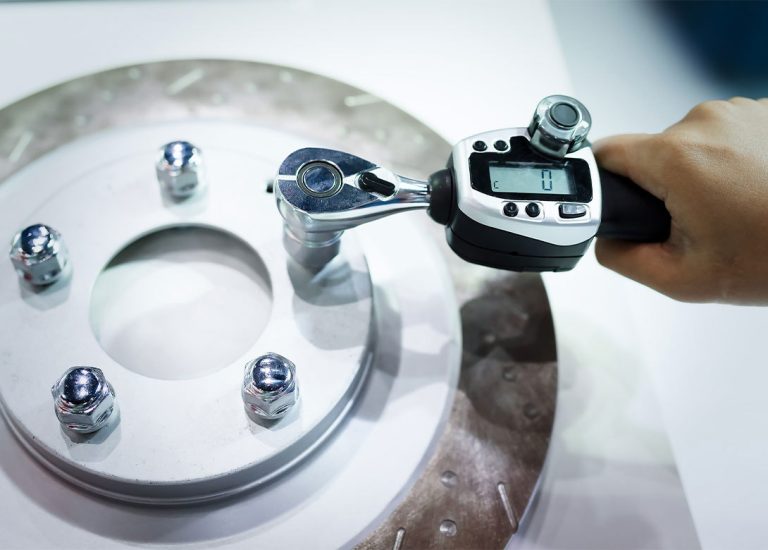
The most common method of controlling the tightening of threaded fasteners is to tighten them to a specified torque. This method is generally known as torque audit. The main issue with this method is that the clamping force (in other words, the clamping tension) generated by applying torque depends on the design of the fastener and the friction conditions during tightening, parameters that are difficult, if not impossible, to control. Despite these major issues, it remains the most common way to ensure a bolt meets a torque specification. Hence the alarming statistics mentioned earlier regarding the automotive industry.
Friction, the major problem in torque tightening
The problem with using torque to indirectly control the clamping force in the fastener is that only a small portion of the torque is actually transmitted into tension in the bolt, to stretch it. The majority of the force is absorbed by friction between the nut face and the joint and in the threads. Some fasteners use a nylon insert or have deformed threads such that torque is required to screw the nut onto an untightened bolt. Interestingly, for the same tension in the bolt, the required torque between predominant and non-predominant types of bolts varies by less than 4%. However, the type of predominant torque nut results in a significantly lower preload (16%). An example of the torque distribution in the fastener for an M10 bolt of property class 10.9 is as follows:
Tension (bolt load/extension): 10%
Thread friction torque: 25%
Nutface friction torque: 65%

Torque audit : an overview
Most large manufacturing companies conduct internal quality torque audits on their assemblies, including checking that threaded fasteners have been tightened to meet technical specifications. There are two approaches to auditing torque. The first is dynamic, where torque is measured directly using in-line transducers attached to the tightening tool. The second approach involves an operator or inspector auditing the torque after tightening is completed.
This list of the most common bolt tightening methods in the industry is not exhaustive. However, it highlights that the solution does not solely lie in the tightening tool used, which has limited precision, but rather in the measurement of the tightening itself. Let’s now address the central question: how do we measure tightening tension? There are several methods in this field as well, each with varying effectiveness.
Dynamic torque audit
The dynamic method yields results independent of the operator’s reading accuracy. Generally, powered tightening tools are used in conjunction with a computerized data collection system. Since this method allows for automatic storage and retrieval of tightening data, it can be an important tool for statistical process control. The drawback of this method is that it is generally expensive in terms of costs and technical skills required for support.
Torque auditing after assembly
There are three basic methods for checking the torques applied to bolts after assembly; namely, taking a reading on a torque gauge when:
The socket begins to move from the tightened position in the tightening direction. This method is often called the “crack-on” method.
The socket begins to move from the tightened position in the loosening direction. This method is often called the “crack-off” method.
The fastener is retightened to a marked position. With the “marked fastener” method, the socket approaches a marked position in the tightening direction. Clear marks are first drawn on the socket and on the joint surface that will remain stationary when the nut is turned. (Avoid marking washers as they can turn with the nut). The nut is loosened about 30 degrees, then retightened so that the marked lines coincide.
Torque in the three methods must be applied slowly and deliberately to minimize dynamic effects on the gauge reading. Always ensure that the non-rotating element, usually the bolt, is securely held when checking torque. The torque reading should be verified as soon as possible after the tightening operation and before any subsequent process such as painting, heating, etc. Torque readings depend on the friction coefficients present under the nut face and in the threads. If fasteners are left too long or exposed to different environmental conditions before verification, friction and therefore torque values can vary. This variation can also be caused by embedment (plastic deformation) of the threads and the nut/joint face surface, which occurs. This embedment results in reduced bolt tension and affects tightening torque. Torque values can vary up to 20% if bolts remain in place for two days.
These methods are archaic and do not ensure proper tightening control. TRAXX does not recommend using such methods, which are far from the precision requirements of the industry.

Torque audit methods : Crack-on and crack-off
With the “crack-on” and “crack-off” methods, there are two ways to check breakaway torque. The first is manual, where the operator “feels” the break point. The second is electronic, using a torque audit wrenche with a strain gauge and automatically recording the breakaway torque. The automatic method eliminates operator variability but remains an outdated and, dare we say, medieval method.
Marked fastener method for torque auditing
The specification of tightening torque is crucial for determining joint reliability. Different thread types and joint surface finishes affect tightening torque. Special fasteners, such as those with predominant torque, flanged heads, or reduced shanks, also require special consideration when determining tightening torque. Predominant torque fasteners use a nylon insert or have deformed threads such that torque is required to screw the nut onto an untightened bolt. For free-spinning nuts, predominant torque is zero.
Residual torque
Residual torque measures the torque needed to turn an already tightened bolt or nut by a small angle (2-5 degrees) in the tightening direction. This method is commonly used across industries to verify the torque value of a fastener without needing to retighten it. Unlike breakaway torque, which is measured in the loosening direction and requires less torque, residual torque offers a more accurate representation of the fastener’s condition.
Despite its name, residual torque does not indicate the presence of torque in the fastener. Instead, it reflects the preload, thread geometry, and friction conditions. The movement during the test is typically felt by the tester, but audit torque wrenches can provide more precise measurements by reducing human error. Marking the fastener and joint and noting movement can also be used, though this can lead to errors, especially with longer bolts where friction between threads is not fully overcome.
Residual torque measurements are often conducted when there are concerns about the integrity of a bolted assembly, such as observed loosening or bolt fatigue. The longer the time between installation and measurement, the greater the uncertainty due to increased friction over time, which can lead to higher torque readings and mask reduced bolt preload. TRAXX strongly advises against this method.
Adhesively locked threads
Extensive testing has shown that locking male to female threads with adhesive gives the fastened assembly excellent resistance to loosening due to vibration. The adhesive can be applied in liquid form at the assembly stage, or the threads can be pre-coated with an anaerobic adhesive that hardens once the parts are assembled.
Most thread-locking adhesives tend to show a higher thread friction coefficient than is normally present in threads, and a slight predominant torque characteristic will also be present. Full curing of the adhesive is generally achieved in 24 hours but depends on the finish applied to the fastener, bonding gap, and ambient temperature. With liquid-applied adhesive, an activator can be used to shorten the curing time.
Measuring assembly torque dynamically at the assembly stage poses no problem when using an adhesive to lock the threads. Problems arise, however, when assembly torque needs to be checked post-assembly. Using any of the three torque audit methods on threads bonded by adhesive is problematic. If the hardened bond is broken to verify the torque, the vibration resistance of the fastened assembly may be compromised. Furthermore, the hardened adhesive in the threads increases the threading friction characteristics so that upon retightening, less torque is devoted to achieving preload and more to counteracting friction. For these reasons, none of the three post-assembly torque audit methods is suitable for threads that have been bonded together with adhesive.
A common method of verifying assembly specification is to retighten the joint to the specified torque while ensuring the male element does not move relative to the female element. The effect of the adhesive is to increase assembly torque so that breakaway torque is 10% to 30% higher than the assembly torque value.
In conclusion, the application of adhesive can prevent some loosening but complicates maintenance and torque control of fastened assemblies. This is why TRAXX recommends, in most cases, the method of measuring bolt load using ultrasonic bolt tension meter as the TRAXX-M2.
Best torque audit tool : ultrasonic bolt tension meter
How it works ? It involves measuring the elongation of the screw or stud under the influence of the tension generated by tightening. Since this elongation is proportional to the tension (assuming, for now, that we limit ourselves to the elastic domain), it becomes possible to deduce the tension by simply applying a coefficient.
The TRAXX-M2 device is one of the systems capable of performing these measurements. The TRAXX-M2 is an ultrasonic bolt load measurement system that allows for very precise control of the tightening of fastened assemblies.
The ultrasonic transducer placed on the head of the screw or stud acts as a transmitter, transforming the electrical pulse supplied by the measurement system into an ultrasonic wave that propagates longitudinally through the material of the screw. Then, as a receiver, it collects the very weakened ultrasonic wave that has reflected off the bottom of the screw, converting it into an electrical signal processed by the measurement system.
The ultrasonic transducer, placed on the head of the screw or stud, performs this operation, which is repeated at a frequency of several hundred or thousands of times per second. At each “shot,” the measurement system times the interval between the emission of the pulse and the return of its echo. Although the principle is similar to that of sonar, the high speed of ultrasound propagation (about 5800 m.s-1 in steel) and the required resolution for elongation (a few micrometers) demand a time measurement resolution on the order of nanoseconds (1e-9 s).
It enables mastering the quality of assemblies on-site and controlling the tightening of threaded connections with accuracy up to 2% of the actual tension! A real advancement in the field of tightening control and torque auditing !