How to control bolt crosstalk during the tightening of a sealing joint ?
Here, we will examine the challenges associated with tightening multiple bolts in a bolted assembly and the effects that individual preload forces can have on the rest of the group—a phenomenon known as elastic interaction.
Controlling bolt crosstalk during the tightening process
Most bolted assemblies comprise several bolts, and because these bolts are not tightened simultaneously, tightening one bolt affects the preload of other previously tightened bolts in the group. This effect is known as elastic interaction or bolt crosstalk.
Reach an uniform stress distribution
Ensuring a uniform stress distribution in the bolts is crucial for sealing joints to minimize potential leaks. However, achieving a uniform load distribution in each bolt is not straightforward, as the final load of the bolts usually differs from the initial load. Here is an illustrative example:
When the two outer bolts are tightened to compress the gasket, followed by tightening the central bolt, this leads to additional compression of the gasket under the two other bolts, resulting in a loss of preload in these two bolts. The bolts relax due to the tightening of the central bolt, compromising the uniformity of the assembly’s tightening.
Tightening sequences: cross pattern or spiral pattern
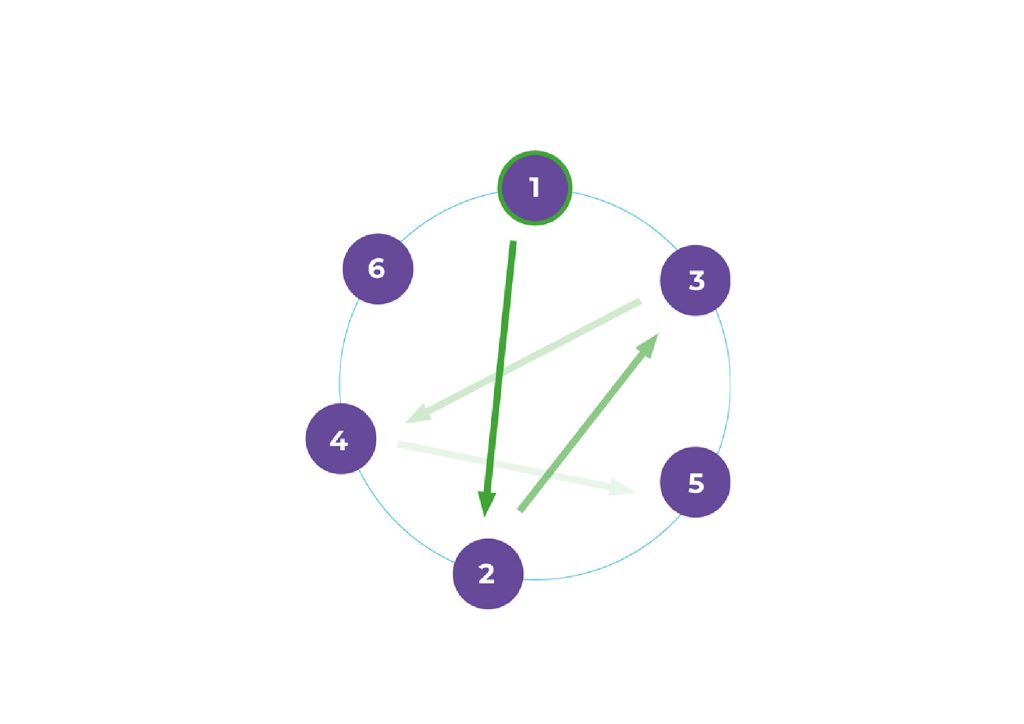
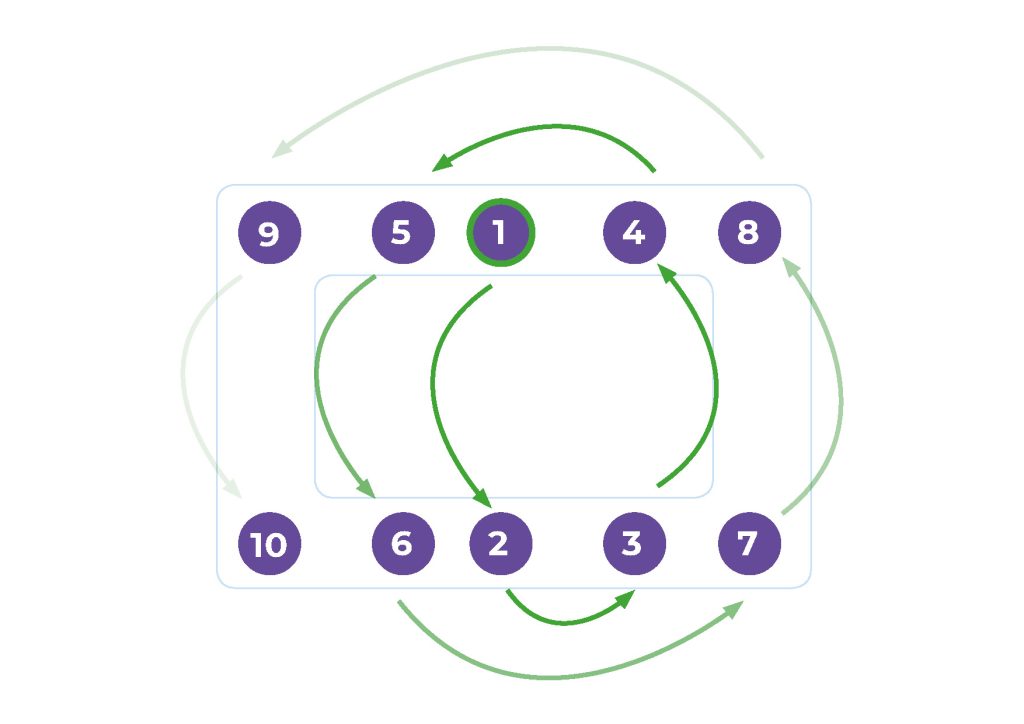
Two classic examples of tightening sequences are one for a rectangular arrangement of bolts and the other for a circular arrangement. These sequences allow for a relatively uniform load distribution, minimizing the dispersion of preload within an assembly. For sealing joints and any type of assemblies, a multi-pass tightening sequence is recommended. During these multiple passes, each bolt is tightened more than once to help reduce the preload reduction caused by the tightening of other bolts in the assembly.
Bolt crosstalk : significant impact of elastic interaction
Tests have shown that elastic interaction between bolts in an assembly can significantly affect the preload, with a reduction of up to 35%. The “softer” the joint—such as a gasket with low stiffness—the more significant the elastic interaction effect can be. A sealing joint, typically of low stiffness, often requires incremental and multi-pass bolt tightening to achieve a uniform load distribution.
Use of pressure-sensitive film
Other tightening sequences can produce a reasonably uniform bolt load distribution. For instance, studies in Japan have shown that after ensuring the joint surfaces are parallel to each other, alternating the tightening of bolts and retightening them several times until no further rotation occurs yields acceptable results. FUJIFILM has manufactured a film that determines the pressure distribution in a bolted assembly. The film, inserted between the gasket plates and tightened, changes color according to the local pressure. The microcapsules in the film react to various degrees of pressure, releasing their colored substance at a density corresponding to the pressure.
Ultrasonic bolt load measurement: a perfect reliability
Applying uniform tightening tension between parts with a TRAXX-M2 during the tightening of a sealing joint ensures a good seal of the assembly. The direct measurement of tightening tension using an ultrasonic sensor allows for precise knowledge of the load present in a bolt at any given moment. During the different tightening passes, it is easy to check all bolts to ensure that the tightening is perfectly uniform across all bolts in the assembly. Furthermore, it is also possible to verify the tension in each bolt of this assembly afterward, as part of maintenance. This long-term monitoring allows each assembly to be maintained at its highest level of quality and sealing over time.