
Table of contents
Bolt stretch : an overview
In this article, we will explore the concept of bolt stretch, including its theoretical foundations, Hooke’s Law, and the elasticity coefficient. We will examine the differences between torque and bolt stretch, highlighting why torque tightening is less effective for bolt stretching. The article will then present bolt tensioning as a superior solution and conclude with methods for measuring bolt stretch and mastering the tightening of bolted joints.
What is stretching a bolt ?
In materials engineering, bolt stretch or extension is defined as the change in length of a material subjected to tension, encompassing the specific range of this dimensional change.
Tightening causes the stretching of a bolt, which is therefore subject to the laws of material deformation. Before we begin, here are some definitions and terminology elements. The intrinsic ability of a material to stretch plastically is identified as its ductility. The following distinctions are observed:
Bolt stretch at the yield point: This refers to the stretching of a material reaching its yield limit, along with the concomitant range of this deformation.
Bolt stretch at break or ultimate stretch: Describing the deformation of a material sample at the breaking point, this measure provides an accurate indication of the material’s ductility.
Limit stretch: For materials with a yield point, exceeding this limit causes a transition into the plastic deformation range. Once the limit is surpassed, further increases in deformation (or tightening) will no longer result in a proportional increase in stress in the bolt.
Permanent bolt stretch: This term refers to the irreversible deformation of vulcanized rubber after a brief period of stretching to a specified length.
Residual bolt stretch: This is a measure characterizing the ductility of a plastic material, evaluating the deformation that remains after stretching ceases.
Finally, extensometry represents the discipline dedicated to the precise measurement of deformations.

How much does a bolt stretch when torqued ?
An important consideration when stretching bolts is understanding that the stretch of the bolt upon full tightening is relatively minimal. For instance, consider an M10 bolt of property class 8.8. When fully tightened in a joint with a thickness of 40 mm, the bolt will experience a stretch of approximately 0.1 mm. This small amount of stretch is what creates the preload within the bolt. The preload is the result of the internal resistance of the bolt material against this stretching.
To elaborate, the concept of stretch in bolts is crucial for ensuring proper preload. In the case of the M10 bolt mentioned, the stretch of 0.1 mm is a precise amount that, although small, plays a significant role in achieving the required clamping force in the assembly. The material of the bolt resists this stretch through its inherent mechanical properties, effectively generating the desired preload that holds the joint securely. This understanding highlights the importance of precise tightening and the role of material properties in maintaining the integrity of bolted connections.
The equation of bolt stretching: Hooke’s law
In 1660, Robert Hooke (1635-1703) formulated the law of elasticity that bears his name, describing the linear variation of tension as a function of extension. This law is summarized in the maxim “Ut tensio sic vis,” meaning “as the extension, so the force,” or “stretching is proportional to the force.” British physicist Thomas Young observed that the ratio between the tensile stress applied to a material and the resulting deformation (a relative stretch) remains constant as long as this deformation is limited and the material’s yield point is not reached. Young then introduced the concept of the modulus of elasticity, now known as Young’s modulus.
Over time, mathematicians have sought to deduce the laws governing these properties based on plausible assumptions about the constitution of bodies. Simultaneously, physicists have tried to understand the underlying molecular forces by studying these laws experimentally.
The results of these experiments led to the following laws:
The stretch lll of a prismatic rod is proportional to its length L.
It is also proportional to the load P acting along the rod’s axis.
It is inversely proportional to the cross-section S of the rod.
It is inversely proportional to a coefficient E, known as the coefficient of elasticity or longitudinal modulus of elasticity, which is characteristic of each substance and measures its ability to stretch.
These stretching laws are summarized in the following formula:

The elasticity coefficient of a bolt is an important parameter for stretch-based tightening
The elasticity coefficient, also known as elastic modulus, remains constant for a given substance, referring to a material that maintains consistent properties under the same physical conditions. In practice, while the elasticity coefficient can vary depending on the molecular structure and temperature of each sample, these variations are generally negligible, allowing the use of an average elasticity coefficient.
The stretch law can be expressed by the following equation, indicating that the elasticity coefficient is the constant ratio between the load applied per unit of surface area and the resulting stretch per unit of length.

Stretch-based tightening: the yield point of a bolt
The laws governing bolt stretching are empirical, and as is often the case with empirical laws, they apply only within specific ranges. The actual laws are far more complex, surpassing linear relationships. However, the previous formula aligns well with experimental results under common conditions.
When a prism is subjected to increasing tension, it undergoes progressive stretching and eventually breaks when the tension reaches a value dependent on the nature of the prism. As long as the tension remains low, not exceeding about one-third of what is needed to cause rupture, the stretching varies proportionally to the load. These stretches are not permanent; they disappear when the tension is removed, and the prisms return to their original length. This return to the original length results from the material’s elasticity, and the load at which the stretches begin to become permanent is called the yield point.
Even with very low tension, there is always some permanent stretch, as highly precise experiments have shown. However, up to the yield point, this permanent stretch is minimal and generally ignored. For instance, in the case of iron, permanent stretching is rarely a concern as long as the tension remains below half of the breaking load, a common practice in real-world applications.
It is important to note that stretching a fastener resulting from extension is always accompanied by a reduction in cross-sectional area and an increase in volume. Although these phenomena are of secondary importance, they are rarely considered. Moreover, the duration of the tension generally influences the stretch, gradually increasing over time and tending toward a specific limit for a given load. This consideration should be taken into account in constructions.
The limit load, also called the theoretical load, represents the load per unit area at which a piece operates at its yield point.
What is the difference between torque and bolt stretch ?
Let’s discuss the relationship between tightening torque and preload. So bolt tension vs torque !
When the fastener is screwed onto the thread, the rotational movement is converted into linear motion, causing the bolt to stretch while the parts are compressed. However, only a small fraction of the applied torque is actually used to preload the bolt. Most of the torque is consumed in overcoming the frictional resistance that opposes the rotation of the fastener.
The influence of friction on torque and preload is significant. Friction occurs between two contact surfaces: between the rotating part and the tightened part (under the bolt head or nut) as well as in the threads. This means that the portion of torque converted into preload is quite limited. Torque or tensile testing helps determine the friction coefficients on the two contact surfaces. Generally, a breakdown of the torque shows that only 10% of the input torque is actually used, with the rest dissipated by friction.
For instance, the torque under the head accounts for 50% of the input torque, and the thread torque for 40%. Therefore, torque-based tightening is not very efficient. Efficiency can be improved by using a low-friction lubricant, thus reducing friction and lowering the required torque to achieve the same preload.
Dispersion is a factor to consider since friction coefficients can vary significantly (usually +/- 20%), leading to variability in the process. Even with precise tightening tools (e.g., +/- 1% for manual torque wrenches), the deviation on the applied torque can range from +/- 10% to +/- 50%. The position and handling of the tools by operators can significantly impact the applied torque. The resulting variation in the achieved preload is commonly accepted at +/- 30%. This means that the maximum preload can be twice as high as the minimum preload, and this dispersion can be even more pronounced on rusty bolts or stainless steel fasteners, which tend to seize.
So, how do you determine bolt’s preload based on the tightening torque? With a bolt stretch calculator.
Bolt stretch calculator
If you wish to calculate bolt stretch using a formula, the Kellerman and Klein formula establishes a relationship between the tightening torque (C0) and the preload (F0) in an assembly:
C0=F0 (0.16P+μmoy(0.583d2+rm)
where:
C0 is the tightening torque,
F0 is the preload,
P is the thread pitch,
μmoy is the average friction coefficient,
d is the mean bolt diameter,
rm is the mean radius.
This formula provides a quantitative expression for determining the required tightening torque to achieve a specific preload in a mechanical assembly.
Schematically, this is the relationship between tightening torque and the preload in a bolt.
Tightening torque table
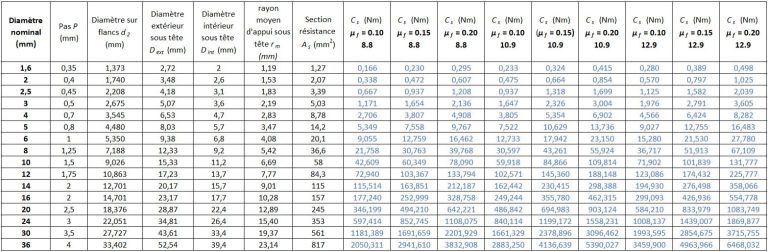
In this torque table, the variations observed in preload/tension result from discrepancies in friction coefficients and tightening methods.
When a bolt is subjected to axial tension, the maximum force induced by torque tightening should not exceed 80-90% of the fastener’s yield strength, which is determined by the bolt’s strength class.
It can be stated that, depending on the friction coefficient, a high torque can lead to a low preload if the friction coefficient is high, and conversely, a low friction coefficient can result in a higher preload with the same torque. Similarly, a conventional tightening process will result in significant dispersion of the preload. Nowadays, improving tightening processes is a fundamental issue in achieving reliable assemblies with threaded elements.
What is bolt tensioning ?
Tensioning involves the direct axial stretching of a bolt to achieve the desired preload. This method effectively removes inaccuracies caused by friction, which are common in traditional tightening processes. Instead of relying on substantial mechanical effort to generate torque, tensioning utilizes straightforward hydraulic pressure to achieve the same result. This approach not only simplifies the process but also enhances precision. Furthermore, tensioning allows for a uniform load to be applied across multiple bolts or studs simultaneously, ensuring consistent clamping force and reducing the risk of uneven stress distribution in the assembly.
How to stretch a stud ?
Stretching a fastener is a complex task that requires both specialized tools and considerable expertise. The process demands precise control to ensure the fastener is stretched to the correct tension without exceeding material limits or compromising performance. This often involves the use of advanced equipment, such as hydraulic tensioners or induction heating systems, to achieve the desired results. There are two predominant techniques used for stretching a stud to achieve optimal tension: hydraulic tensioning and induction heating.
Hydraulic tensioning
Hydraulic tensioning is a technique used for tightening bolts, especially in large-scale installations. This method utilizes a hydraulic cylinder to apply a pulling force on the bolt, causing it to stretch. Once the bolt is elongated, the nut is tightened onto the bolt, and the hydraulic pressure is released. This transfer of force from the hydraulic cylinder to the bolt occurs through the nut. By knowing the force exerted by the hydraulic cylinder, the applied force on the assembly can be accurately determined.
While hydraulic cylinders are good bolt stretcher and generally offer precision within a range of 1% to 5% depending on the model and conditions, the final uncertainty in assemblies is typically around ±15%. This higher uncertainty is mainly due to variations in nut tightening. Although hydraulic tensioning is more precise compared to other methods, it does have some drawbacks. Not all bolts within an assembly can be easily connected to the hydraulic cylinder. Accessing the ends of the bolts for the hydraulic pull can be challenging, particularly in complex assemblies where such access may not be feasible.

Induction heating for stud tightening
Induction heating for bolt tightening involves using heat generated by an alternating magnetic field to temporarily expand a component, making assembly easier. By locally heating the area being tightened, the material becomes more pliable, allowing for a precise fit. This type of bolt stretcher is commonly used in the automotive industry, particularly for tasks such as fitting bearings onto shafts. Accurate control of both temperature and heating duration is essential to ensure effective tightening while preserving the material’s properties.
Despite its advantages, induction heating is a complex process that can result in unintended thermal effects on adjacent parts and other complications. As a result, this method is not widely used across all industries.

Bolt stretch gauge
A bolt stretch gauge is a precision tool used to measure the elongation of a bolt when it is tightened. By determining how much a bolt stretches under tension, the gauge helps ensure that the bolt is tightened to the correct preload, which is crucial for maintaining the integrity of bolted connections. The gauge is attached to the bolt or positioned to measure the distance between reference points on the bolt before and after tightening. There are various types of stretch gauges, including mechanical, digital, and optical models, each offering different levels of precision and ease of use.
Limitations of rod bolt stretch gauge
The main challenge with using a rod bolt stretch gauge is that both ends of the bolt must be accessible to perform the measurement accurately. This requirement can be problematic in assemblies where space is limited or where other components obstruct access to the bolt ends. Without clear access, it becomes impossible to measure the elongation of the bolt, which is essential for determining the correct preload. This accessibility issue can limit the application of bolt stretch gauges in complex or confined assembly environments, making it a significant consideration in the selection and use of this measurement tool.

How do you measure bolt stretch ?
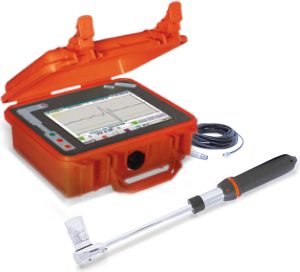
With TRAXX, you can bypass the need for calculating the strength or preload of a bolt because this method involves directly and empirically measuring the preload in the bolt. By performing a tensile testing on bolts prior to tightening and measuring their stretch based on the applied force, the TRAXX method defines a proportionality coefficient, K, between these two quantities. This allows you to precisely know the tension force in the bolt during tightening by measuring its actual stretch using ultrasonic bolt load measurement device, as TRAXX-2. Thus, your stretch tightening is accurate, reliable, and reproducible across all the bolts in your bolted assembly.
Ultrasonic bolt tension measurement : the optimal solution
Understanding bolt tension is essential for accurate assembly. Ultrasonic bolt load measurement provides a highly precise method for assessing bolt tension after preload. But what does ultrasonic bolt preload measurement involve? This technique sends an ultrasonic signal through one end of the fastener and measures the time it takes for the signal to return to the transducer. By analyzing this time, we can determine the elongation of the bolt, using the unloaded fastener length as a reference. The difference between the bolt’s length before and after preload allows for an accurate calculation of the tension within the bolt.
Ultrasonic measurements are crucial for verifying torque applications and can significantly reduce preload variation. Unlike deflection validation, ultrasonic techniques are suitable for applications involving blind holes, as they only require access to one end of the fastener.
Additionally, if the unloaded length of the fastener is known before applying preload, ultrasonic measurements can accurately assess residual preload levels, ensuring that bolts meet specified tolerances.
