
Table of contents
What is an extensometer ?
An extensometer is a sensor designed to measure deformation or displacement within a narrow measurement range during mechanical tests. It can be applied to a component or sample subjected to tension, compression, or torsion.
What can be measured with an extensometer ?
An extensometer allows bolt load measurement through longitudinal, transverse, or bi-axial deformation In our range, we also offer sensors for measuring toughness (rupture), bending, and torsion. The measurement range is expressed in “% strain,” meaning that a +20% measurement range (tensile) represents a deformation of 200,000 µm/m. If the sensor has a 25 mm base, you will have a measurement range of +5 mm. Important note: The measurement range is not necessarily symmetrical if you work in both tension and compression (for example, a measurement range of +20% in tension and -10% in compression).
Extensometers are essential in various tests, especially in mechanical tests to characterize materials. They play a crucial role in stress analysis to determine or calculate parameters such as elasticity modulus and elongation at rupture. Extensometers provide valuable insights into material behavior under different mechanical conditions.
Industrial extensometers
Industrial extensometers are crucial instruments designed to measure deformation in various industrial applications. This deformation can be attributed to stress, force, or displacement within a structure. These devices are securely attached to a structure using a set of screws/nuts or can be welded directly onto the frame. The sensors are capable of directly measuring force through calibration, providing accurate and reliable data.
One notable feature of these extensometers is their robust construction, making them suitable for outdoor installations. With an IP68 protection rating, they can withstand challenging environmental conditions. The output, whether in analog form or as a complete strain gauge bridge, is directly proportional to the deformation, ensuring precise and consistent measurements.
These industrial extensometers play a vital role in material characterization and structural analysis, aiding in the determination and calculation of parameters such as elasticity modulus and rupture elongation. Their versatility and durability make them indispensable tools in various industries where accurate measurement of deformation is paramount.
What is a standard bolt extensometer ?
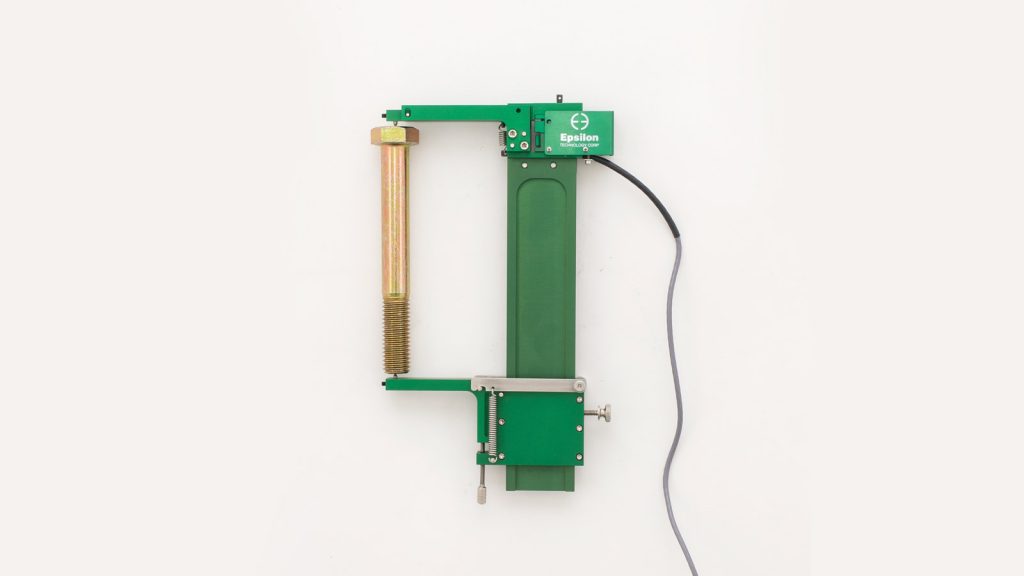
Developed for precisely measuring small strain ranges essential for proof load testing of bolts and similar applications such as yield measurement, the bolt extensometer is a sophisticated tool engineered with meticulous attention to detail.
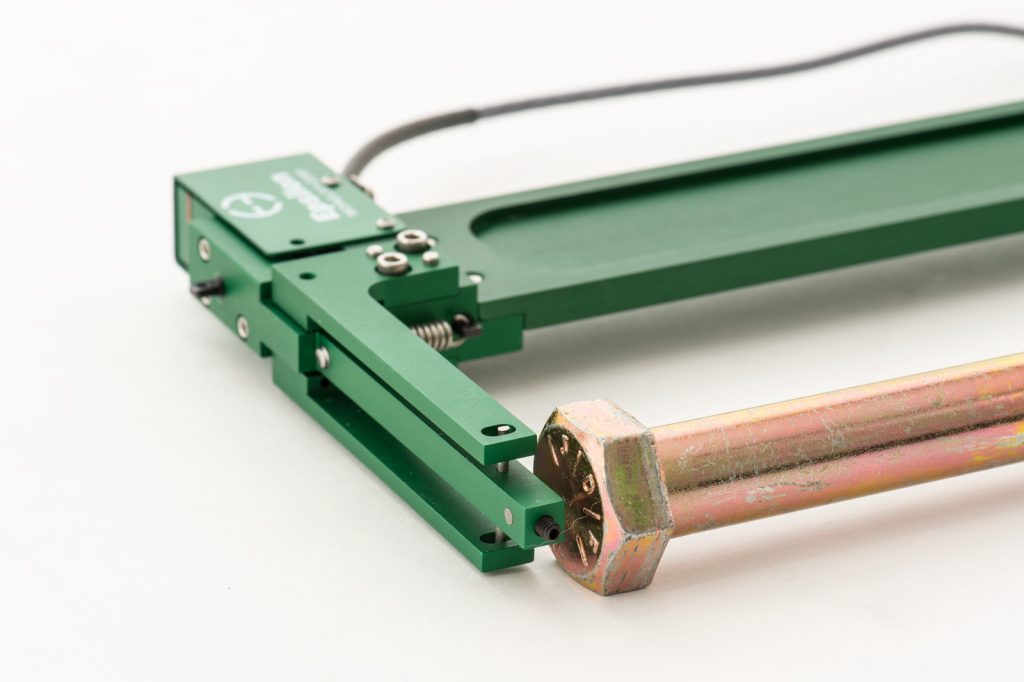
The extensometer employs robust conical points to establish contact with the bolt at both the center of the head and the bottom. Its adaptability is noteworthy, offering full adjustability for different length bolts within the standard range of 1 inch (25 mm) to 6 inches (150 mm). Extension beams are available to accommodate longer bolts, providing a comprehensive solution for various testing scenarios.
With a standard maximum measuring range of 0.05 inches (1.25 mm), the bolt extensometer is designed to be self-supported on longer bolts, eliminating the need for centering marks or punch marks. However, for shorter bolts, these marks may be necessary, unless the conical pins are sufficiently sharp, rendering the marks unnecessary even on the shortest bolts.
Equipped with a zero adjustment screw, the bolt extensometer allows for precise adjustment of the length between the contact pins. This facilitates the calibration process by setting the output voltage to zero, aligning with the correct starting position for the test. The inclusion of a breakaway lower arm is a notable safety feature. In the event of a bolt failure, the breakaway arm detaches, mitigating the risk of damage to the bolt extensometer. Easy re-installation ensures minimal downtime.
For situations where bolt failures are anticipated, a recommended precaution is attaching a cord around the upper part of the beam, securing the other end to the test frame to prevent the extensometer from falling.
The conical point contacts, constructed from tungsten carbide, exemplify the extensometer’s commitment to durability and precision. These strain-gaged devices are compatible with electronics designed for strain-gaged transducers, typically connected to a test machine controller. Signal conditioning electronics are often included with the test machine controller or can be added separately.
The bolt extensometer stands as a testament to innovation, providing a reliable and sophisticated solution for accurate strain measurement in bolt testing applications.
Standard Bolt extensometer main features
Its rugged and dual flexure design enhances performance, providing reliability and accuracy in various testing scenarios.
For convenient transport and storage, each extensometer comes with a high-quality foam-lined case, ensuring protection and longevity.
A valuable safety feature is the breakaway arm, strategically designed to prevent extensometer damage in the event of a bolt failure.
Notably, the extensometer is self-supporting on the bolt specimen, eliminating the typical need for centering or punch marks and simplifying the testing process.
Inconveniences that need to be considered
Using standard bolt extensometers for bolt tension monitoring comes with certain inconveniences that need to be considered:
- Accessibility Requirements: Bolt Extensometers necessitate access to both sides of the bolt to measure elongation accurately. In situations where only one side, such as the screw head, is accessible, the extensometer may not function optimally, limiting its applicability in certain scenarios.
- Limited Bolt Length Range: While the Bolt Extensometer is adjustable to accommodate different length bolts, it has a specified range from 1 inch (25 mm) to 6 inches (150 mm). Consequently, it may not be suitable for applications involving bolts outside this length range.
- Manual and Sequential Operation: The Bolt Extensometer necessitates a one-by-one measurement approach conducted by an operator holding the extensometer. This manual process can be time-consuming and intricate, potentially hindering the overall efficiency of industrial operations.
- Cost Implications: The initial cost of acquiring and implementing Bolt Extensometers for bolt tension monitoring can be relatively high compared to some alternative methods.
- Environmental Sensitivity: Certain types of Bolt Extensometers may be sensitive to environmental conditions, such as temperature fluctuations, which could affect their accuracy. Additional measures might be necessary for corrections.
- Calibration Requirements: Regular calibration is often needed to maintain the accuracy of the measurements. This process incurs additional costs and requires dedicated time and resources.
- Complex Installation: The installation and integration of Bolt Extensometers may be more intricate compared to alternative methods of bolt tension monitoring, requiring skilled personnel and additional efforts.
- Structural Impact: The presence of Extensometers during installation can potentially alter the structure of the assembly, and careful consideration is needed to minimize any impact.
Despite these challenges, it’s essential to weigh them against the advantages of using Bolt Extensometers, which provide precise and real-time bolt tension measurements critical for ensuring the integrity and safety of bolted connections.
A comparative analysis of three bolt extensometers available in the market
Technology
- Epsilon Bolt Extensometer: Utilizes strain gaged design, suitable for various test systems.
- Max II Ultrasonic Bolt Extensometer: Integrates standard ultrasonic technology for bolt load measurement.
- TRAXX-M2 Ultrasonic Bolt Extensometer: Utilizes advanced ultrasonic technology, providing precise and efficient bolt tension measurement.
Advantage TRAXX-M2: The TRAXX-M2 stands out with its cutting-edge ultrasonic technology, offering superior accuracy and reliability in bolt tension measurements.
Measurement Speed
- Epsilon Bolt Extensometer: Manual and sequential measurement, potentially time-consuming.
- Max II Ultrasonic Bolt Extensometer: Introduces ultrasonic technology, improving measurement speed.
- TRAXX-M2 Ultrasonic Bolt Extensometer: Optimizes measurement speed through advanced ultrasonic capabilities.
Advantage TRAXX-M2: TRAXX-M2 excels by combining ultrasonic technology with efficient measurement processes, ensuring quick and reliable results.
Range and Adaptability
- Epsilon Bolt Extensometer: Adjustable for bolts from 1 inch (25 mm) to 6 inches (150 mm).
- Max II Ultrasonic Bolt Extensometer: Limited information provided.
- TRAXX-M2 Ultrasonic Bolt Extensometer: Offers versatility across a wide range of bolt lengths and diameters. It supports a broad range of lengths, spanning from 5 mm to an impressive 14 m. Additionally, the Traxx-M2 is designed to handle screws with diameters ranging from 2 mm to 500 mm.
Advantage TRAXX-M2: TRAXX-M2 provides adaptability to various bolt dimensions, ensuring comprehensive coverage for different applications.
Ease of Use
- Epsilon Bolt Extensometer: Manual operation may require skilled handling.
- TRAXX-M2 Ultrasonic Bolt Extensometer: User-friendly design and advanced technology simplify the measurement process
Advantage TRAXX-M2: TRAXX-M2 ensures user-friendly operation, reducing the complexity associated with manual and other ultrasonic systems.
Industrial Efficiency
- Epsilon Bolt Extensometer: Manual, one-by-one measurements may impede industrial efficiency.
- TRAXX-M2 Ultrasonic Bolt Extensometer: Integrates seamlessly into industrial processes, optimizing efficiency with advanced ultrasonic capabilities.
Advantage TRAXX-M2: TRAXX-M2 aligns with industrial efficiency standards, providing swift and automated bolt tension measurements.
In summary, TRAXX-M2 surpasses both Epsilon and Max II in terms of technology, measurement speed, range, ease of use, and industrial efficiency, making it the superior choice for precise and efficient bolt tension monitoring.
