
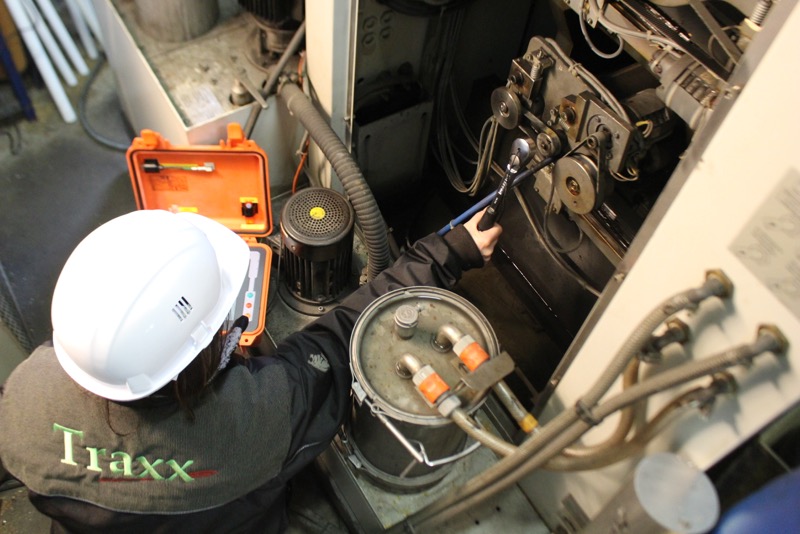
Measuring the tension of bolt tightening is a common need in most industrial sectors: automotive manufacturers, energy producers, railway industry, aerospace, heavy industry… These are demanding fields where the precision of tightening and measurement instruments is crucial. Michel BERBESSON, Technical Director of the company TRAXX, shares his expertise on bolt tightening tension to help you understand the issue and choose the right tightening method.
Why should we start bolt load measurement ?
I am surprised that the question is still being asked…
Technology is advancing rapidly, and one thing is clear today for serious and conscientious industrialists: torque measurement of screws no longer meets the precision and reliability requirements of modern technical industry. Now everyone thinks in terms of tension, from design to maintenance! Measuring bolt tension guarantees that the optimal tension has been applied to a given series of screws. It provides additional insurance on the reliability of an assembly. It helps to understand and anticipate any potential breakage between two parts. In short, thinking in terms of tension means thinking better.
What methods are currently available for measuring bolt load ?
n the field of bolt tension measurement, no method meets the current needs of industry, except for TRAXX. While some methods do exist, such as load cell methods and strain gauge methods (which have the major disadvantage of altering the nature of the assembly for measurement purposes), they are intrusive and difficult to set up. These methods are unsuitable for on-site use and are limited to laboratory experimentation. I will not delve into “smart screws,” which in my opinion are the current technical aberration. What is intelligent about implanting a permanent sensor in all the screws of an assembly? In addition to altering the nature of the screws, this preliminary work for measurement is heavy, costly, and completely unnecessary. TRAXX does without it.
How does TRAXX position itself in the tension bolting market?
With TRAXX, bolting and measurement become inseparable. At TRAXX, we bolt directly in tension. The advantages of our method: the ultrasonic measurement system does not require any modification to the nature of the bolts or the assembly. The method simply involves placing a mobile sensor on the bolt being tightened. We guarantee bolting (in kN) with a precision of 3 to 5% on the tension. And it is this guarantee that our clients (PSA, Ferrari, ALSTOM, EDF, AIRBUS, to name a few) particularly appreciate.
Here are some specific examples of applications?
Today, TRAXX offers complete bolt tightening solutions that involve taking full responsibility for an assembly on site. Recently, we worked at GE in Greenville, USA, to oversee the assembly of the new 7HA gas turbine (350 MW). All data and parameters of the tightening are recorded by our system. Thus, in the future, it will be easy to detect a loosening or anomaly on the turbine.
Another example: CLAAS is currently conducting endurance tests on tractor chassis screws in operation, subjected to test courses. With our on-board real-time measurement system, engineers identify breakage scenarios and risk points on their machines. The applications are endless, we discover new ones every day. Today, TRAXX tightens everything from the chassis of a CLAAS tractor to the fuselage of the Rafale.