Tightening screws in a production process, performing quality control and maintenance, and monitoring the behavior of an assembly over time are tasks that require a high degree of rigor and methodology. To accomplish this, it is crucial to have precise and reliable tools and tightening methods.
Tightening is a part of our daily lives, but it is an act that requires great rigor, especially in the age of quality control and monitoring.
Tightening by guesswork
“Tightening by guesswork” is, unfortunately, a widespread practice in the industry and is very risky. To ensure that all the parts of your assembly are perfectly assembled, it is necessary to know the precise elastic limit of the screw and to tighten it using a rigorous method.
Tightening by guesswork does not guarantee the required tightening force. As a result, either the tightening will be insufficient, or it will be excessive, which can lead to the breakage of the screw or nut and damage the assembly. In any case, this exposes the user to an increased risk of breakage, which is dangerous for users and for productivity.
Limiting Risks
Limiting this risk of breakage is possible with TRAXX. Our tightening experts recommend three steps to help you limit this risk:
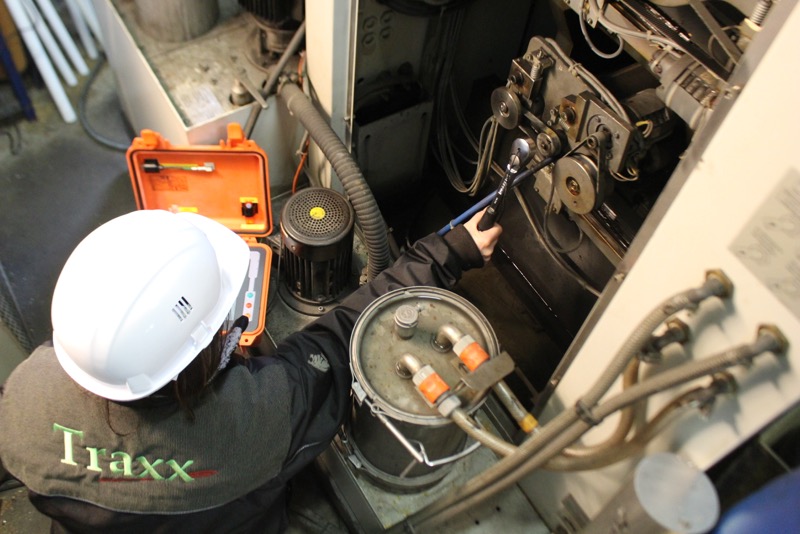
Perform the tightening with a tool adapted to your needs: a hydraulic tensioner, a torque wrench, or others.
In real-time with a TRAXX-M2, monitor the tightening force induced in the screw during tightening. This tightening force is expressed in kilonewtons. When the optimal tightening force is reached, stop tightening.
Trace the tightening performed, store the data in the TRAXX-M2 device, and transfer the results to your internal server. This way, the tightening data is memorized (identification and type of screw, its tightening force, the date of tightening, and the date of the next maintenance check).
You control the tightening state of an assembly at any time.